


Here is the number that changes how most people think about freelancing.
In 2026, there are 1.57 billion freelancers worldwide — representing roughly 46% of the global workforce. The global freelance market is valued at $455 billion. And the fastest-growing segment of that market is not experienced professionals transitioning from corporate jobs. It is beginners — people with one learnable skill, a laptop, and an internet connection — who are building income streams that did not exist five years ago.
That context matters because most people who ask “what is freelancing and how do I earn money online” are not asking an academic question. They are asking whether it is real, whether it works for someone with their background, and whether the learning curve is something they can actually get through.
The honest answers are: yes, yes, and yes — with important caveats that most freelancing guides skip because they are trying to sell you a course. This guide is not selling anything. Here is the full picture.
What Is Freelancing — The Real Definition
Freelancing means providing services to clients using a skill you have, on a project-by-project basis, without becoming a permanent employee of any single company.
You work when you have clients. You earn based on what you deliver. You set your own rates, choose your own clients, and decide how many projects you take on at once. There is no fixed salary, no guaranteed monthly income, and no boss telling you what to do every day.
That last part — no boss — is what most people focus on when they imagine freelancing. The part they underestimate is what it replaces the boss with: the responsibility of finding clients, managing your own time, delivering work to professional standards, handling difficult revision requests, and chasing payments when they are late.
Freelancing is not freedom from responsibility. It is a different kind of responsibility — one that rewards the people who can manage it and frustrates the people who expected something easier.
The distinction between freelancing and employment comes down to three things:
- How you are paid: Employees receive a salary. Freelancers are paid per project or per hour.
- Who controls your work: Employees work within a company’s structure. Freelancers define their own working process.
- Job security: Employees have contracts. Freelancers have client relationships — which can be more or less stable depending on how well you build them.
Neither model is better in absolute terms. Freelancing is better for people who have a skill the market values, can tolerate income variability, and are willing to run the business side of their career alongside the creative or technical side. Employment is better for people who value predictability and prefer to focus entirely on their craft without managing client relationships.
How Does Freelancing Actually Work — The Basic Model
The freelancing model is simpler than most people assume once you understand the three components it requires.
A skill. This is the non-negotiable foundation. Freelancing is not a career path — it is a way of selling a skill. The most in-demand freelancing skills in 2026 include content writing, graphic design, video editing, web development, social media management, SEO, virtual assistance, and AI prompt engineering. None of these require a degree. All of them can be learned online, often for free, with consistent practice over 60 to 90 days.
A platform or a client source. Freelance platforms — Fiverr, Upwork, Freelancer, PeoplePerHour — are online marketplaces where clients post projects and freelancers offer services. They handle payment processing, provide some protection for both parties, and give new freelancers a place to start before they have their own client network. Direct clients — businesses or individuals you find and pitch yourself — typically pay better rates but require more effort to acquire.
A way to demonstrate your capability. Clients cannot hire you based on your word alone. They need evidence — a portfolio of work that shows you can deliver what you are claiming. For new freelancers with no paid client history, this means creating sample work: a writing portfolio of articles on topics relevant to your target clients, a design portfolio of logos or social media graphics, or a video editing showreel demonstrating your style and technical level.
These three components — skill, platform, and portfolio — are what every freelancer needs before they can earn their first dollar. Everything else, including your rate, your niche, and your client communication style, develops from there.
What Freelancing Is Not — The Misconceptions That Cost Beginners Six Months
The internet is full of freelancing success stories that create expectations no real freelancing career can meet in its first 90 days. Getting these misconceptions out of the way early saves significant frustration.
Freelancing is not passive income. You work, you get paid. You stop working, you stop getting paid. Passive income — earning while you sleep — requires either digital products, investments, or a business that runs without you. Active freelancing is none of those things. It is highly skilled labour, delivered on demand.
You will not get clients in your first week. The timeline for a new freelancer’s first client varies — typically 2 to 6 weeks if you are actively promoting your services and 2 to 4 months if you are relying solely on Fiverr or Upwork’s algorithm. Setting this expectation correctly before you start prevents the “nothing is happening” panic at week three that makes most beginners give up.
Low prices do not guarantee more clients. Charging $5 for work that should cost $50 does not make you more competitive — it signals that you do not value your own work, which makes clients question whether the work is worth anything. Price based on the value you deliver, not on your anxiety about being rejected.
Certifications matter less than results. Clients hire freelancers who can solve their problems, not freelancers who have completed the most courses. A portfolio of three strong, relevant work samples outweighs any certificate from any platform. Build your portfolio before you worry about credentials.
How to Start Freelancing — The Honest Step by Step
Here is the sequence that actually works for beginners in 2026 — not the idealised version, but the practical one that accounts for the realities of starting from zero.
Step 1 — Choose one skill and commit to it for 90 days. The most common beginner mistake is skill-switching. You start with writing, get frustrated after two weeks, switch to design, get frustrated, switch to video editing. Three months pass and you have developed none of these skills to a marketable level. Pick one skill that aligns with your existing interests and abilities, and commit to it for 90 days regardless of how the first few weeks feel.
Step 2 — Develop the skill to a minimum viable standard. Minimum viable means: good enough that a client who pays you $30 to $50 for the work will be satisfied with what they receive. Not perfect. Not the best in the world. Good enough. For writing, this means clear structure, correct grammar, and the ability to cover a topic comprehensively. For design, it means understanding layout, typography, and colour. For video editing, it means smooth cuts, good pacing, and basic colour correction.
Step 3 — Build three to five portfolio pieces. Before you create any profile on any platform, create the work samples you will show clients. Write three articles on topics relevant to your target clients. Design five logo concepts in different styles. Edit three short videos demonstrating different techniques. These samples go into your portfolio and answer the client’s first question — can this person actually deliver what they are saying?
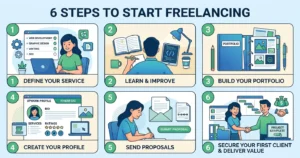
Step 4 — Create an optimised profile on one platform. Start with Fiverr or Upwork — not both simultaneously. A professional headshot, a specific and clearly written bio, and three well-described service offerings are the foundation. The bio should explain what you do, who you do it for, and what makes your approach worth paying for. Avoid generic statements like “I am a passionate writer” — every profile says that. Be specific about your niche and your delivery standard. If you want to understand exactly how to build a Fiverr profile that converts visitors into clients, our guide on how to make money on Fiverr in 2026 covers every element from photo to pricing.
Step 5 — Apply for work actively, not passively. New freelancers who create a profile and wait for clients to find them wait a long time. Active client acquisition means responding to Buyer Requests on Fiverr, sending proposals on Upwork, sharing your portfolio on LinkedIn, and reaching out directly to small businesses whose websites or social media content clearly needs improvement. The ratio of applications to responses will be low at first — expect to send 20 to 30 proposals before receiving your first serious enquiry.
Step 6 — Deliver your first projects at a higher standard than the client expected. Your first three to five clients determine whether you build a reputation on your chosen platform or start from zero every time. Over-deliver on these early projects. Respond faster than the client expects. Submit work before the deadline. Include a brief explanation of your decisions so the client understands the reasoning behind your choices. These behaviours generate five-star reviews, which are the single most valuable asset a new freelancer can build.
How Much Can You Earn Freelancing — Real Numbers
The income data on freelancing in 2026 is more encouraging than most people assume — and more variable than most success stories suggest.
| Experience Level | Monthly Income Range | Timeline |
|---|---|---|
| Beginner (0-3 months) | $0 — $300 | Learning phase |
| Early (3-6 months) | $300 — $1,000 | First consistent clients |
| Intermediate (6-12 months) | $1,000 — $3,000 | Repeat clients building |
| Experienced (1-2 years) | $3,000 — $8,000 | Specialisation premium |
| Expert (2+ years) | $8,000 — $20,000+ | Niche authority |
These ranges are realistic for freelancers working consistently in high-demand skill categories. The variance within each range depends on niche, platform, geographic market, and how aggressively you market your services.
The skills that command the highest rates in 2026 are not necessarily the hardest to learn. AI prompt engineering, for example, is highly learnable and commands $50 to $150 per hour because demand far exceeds supply. Copywriting for high-converting sales pages commands $500 to $2,000 per project because the skill directly impacts client revenue. For a full breakdown of which specific skills are earning the most in 2026, our guide on the Top Freelancing Skills in 2026 covers the most in-demand capabilities with realistic rate ranges.
The Mistakes That End Most Freelancing Careers Before They Start
The first mistake is starting without a specific skill. “I want to be a freelancer” is not a business plan. “I want to provide SEO content writing services to SaaS companies charging $0.15 per word” is. Specificity is the difference between a freelancing career and a freelancing experiment.
The second mistake is copying other freelancers’ profiles and proposals. Clients read dozens of proposals. They can identify templates and copied content immediately — and they do not hire the people who use them. Every proposal should reference the specific project, address the client’s specific problem, and explain specifically how you will solve it.
The third mistake is treating the first income as a sign the strategy is working and immediately increasing prices or decreasing effort. Consistency matters more than any single win. The freelancers who build sustainable income are the ones who deliver the same standard on their fiftieth project as they did on their first.
The fourth mistake is working without a contract on large projects. Even informal written agreements — a message thread that clearly states the scope, deadline, and payment terms — protect you when clients change their requirements after delivery and expect additional work without additional payment. Scope creep is the most common cause of unpaid work in freelancing, and it is almost entirely preventable with clear upfront agreements.
The fifth mistake is staying on one platform forever. Fiverr and Upwork take 20% of every transaction. As your reputation builds, direct clients — acquired through LinkedIn, referrals, or your own website — pay the same rates without the platform commission. Most successful freelancers use platforms to build their initial reputation and then transition the majority of their work to direct relationships within 12 to 18 months.
Why Freelancing Works Particularly Well for Students and Beginners
Freelancing has a structural advantage for people who are early in their careers that is rarely acknowledged: it rewards learning speed more than experience depth.
A student who spends 60 days genuinely developing a marketable skill can earn money from it before graduating. A fresh graduate who combines degree-level knowledge with freelancing platform experience has a professional portfolio that most job applicants lack. And the skills developed through real freelancing work — client communication, deadline management, quality control, and self-direction — are the skills that employers consistently rate as most valuable in entry-level candidates.
Freelancing while studying is not a distraction from building a career. Done thoughtfully, with one skill and one platform as the focus, it is arguably the most effective career investment available to a student in 2026. For students specifically who want to understand how AI tools can accelerate the learning and execution of freelancing work, our guide on the best AI tools for students in 2026 covers the tools that are most directly applicable.
What Comes Next
The freelancing market in 2026 is more accessible than it has ever been — and more competitive at the generic level than it has ever been. The gap between these two facts is where the opportunity lives.
Generic freelancers — those offering broadly defined services without a clear niche or demonstrated expertise — face intense price competition from a global pool of providers. Specific freelancers — those who offer clearly defined services to clearly defined clients at a clearly defined standard — face far less competition and command significantly higher rates.
The path from beginner to sustainable freelancing income is not short. It is also not as long as most people assume when they are standing at the beginning of it. Sixty days to a marketable skill. Thirty days to a first client. Ninety days to a pattern of consistent work. Six months to an income that changes your financial picture.
One skill. One platform. Sixty days. That is where it starts.
