

Here is the number that most freelancing guides bury in footnotes.
The average hourly rate for freelancers on Upwork increased 12% between 2024 and 2026 — while the number of available freelancers on the platform grew by only 4%. Demand is outpacing supply. For anyone with a marketable skill, that gap represents the most accessible income opportunity available right now without a degree, without a job application, and without a boss approving your schedule.
But here is the part that matters: not all freelancing skills are created equal. The gap between the lowest-paid and highest-paid freelancing categories is not 10% or 20%. It is 400%. A data entry freelancer earns $8 to $15 per hour. An AI automation specialist earns $75 to $150 per hour. Both are working from a laptop. Both are available to beginners willing to learn. The difference is entirely in the skill they chose to develop.
This guide covers the freelancing skills that actually pay well in 2026 — with real rate ranges, honest learning timelines, and the specific platforms where each skill generates the most consistent income.
Why 2026 Is the Best Time to Start a Freelancing Skill
The freelancing market in 2026 is the most accessible it has ever been — and the most rewarding for people who choose the right skills. There are 1.57 billion freelancers worldwide, representing 46% of the global workforce. The global freelance market is valued at $455 billion, growing at 15% annually.
The structural shift that most people have not noticed is where the growth is concentrated. Routine, low-skill freelancing — data entry, basic transcription, simple scheduling — is being automated. The freelancing skills that are growing fastest are the ones that require genuine expertise, creative judgment, or technical capability that AI tools amplify rather than replace.
The freelancers who are earning the most in 2026 are not competing with AI. They are using AI to multiply their output — producing more work in fewer hours, at a higher quality level, and charging for the expertise that makes the AI useful rather than generic. If you are starting your freelancing journey and want to understand the complete picture of how freelancing works before choosing a skill, our guide on what is freelancing and how to earn money online covers the full foundation.
The Honest Framework — How to Choose the Right Skill
Before the skill list, here is the selection framework that separates a good choice from a frustrated six-month experiment.
The best freelancing skill for you sits at the intersection of three factors: market demand — are businesses actively paying for this skill; learnable within 60 to 90 days — can you reach a minimum viable standard without a degree or years of experience; and sustainable — will this skill still be in demand in two to three years as AI capabilities expand.
Every skill on this list meets all three criteria. The ones that do not — basic data entry, simple file conversion, routine scheduling — have been deliberately excluded because the rate compression in those categories makes them poor investments of learning time in 2026.
Skill 1 — AI Prompt Engineering and Workflow Design
Hourly rate: $50 to $150 Learning timeline: 30 to 60 days Best platforms: Upwork, direct clients, LinkedIn
This is the highest-growth freelancing skill of 2026 — and the one with the largest gap between demand and available talent.
AI prompt engineering is not about talking to ChatGPT. It is about designing prompts, workflows, and systems that use AI tools to solve specific business problems consistently. A business owner who uses ChatGPT and gets inconsistent results has a prompt engineering problem. A freelancer who can design a system that produces consistent, professional-quality output every time has a skill that business owners will pay significant rates to access.
The specific applications generating the most income in this category include designing content production workflows for marketing teams, building customer service response systems using AI, creating automated reporting pipelines, and developing AI-assisted research processes for specific industries.
The honest learning path is straightforward: spend 30 days deeply learning one AI tool — ChatGPT, Claude, or Gemini — understanding not just what it can do but why it produces inconsistent results and how to engineer around those inconsistencies. Then document your system and offer it as a service to businesses in a niche you understand.
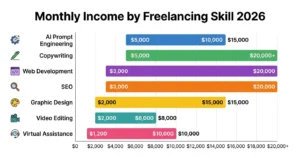
Realistic income: Beginners with a documented workflow in one niche earn $500 to $1,500 per month. Established AI workflow specialists with multiple clients earn $5,000 to $15,000 per month. The ceiling is genuinely high because the skill is rare relative to demand.
Skill 2 — Copywriting and Conversion Writing
Hourly rate: $50 to $200 — or $500 to $3,000 per project Learning timeline: 60 to 90 days Best platforms: Upwork, direct clients, Contra
Copywriting is the skill of writing words that make people take action — buy a product, sign up for a newsletter, click a button, schedule a call. It is the highest-margin writing skill available to freelancers because the output is directly tied to client revenue. A landing page that converts at 3% instead of 1% can be worth hundreds of thousands of dollars to a business. Clients who understand this pay accordingly.
The distinction between copywriting and content writing matters. Content writing informs and educates — blog posts, articles, guides. Copywriting persuades and converts — sales pages, email sequences, ad copy, product descriptions. Content writers typically earn $0.05 to $0.20 per word. Copywriters typically earn $0.50 to $3.00 per word for equivalent output — because the output drives revenue rather than just filling a website.
The skills that separate effective copywriters from average ones are understanding buyer psychology — why people make purchasing decisions and what objections prevent them — and the ability to translate complex product benefits into language that resonates with a specific audience. Neither requires a marketing degree. Both can be developed through deliberate study and practice within 90 days.
Best niches for copywriting in 2026: SaaS products, health and wellness, financial services, and e-commerce. All have high demand and high willingness to pay for copy that converts.
Realistic income: Beginner copywriters earn $500 to $2,000 per month in their first 3 months. Established copywriters with a defined niche and proven conversion track record earn $5,000 to $20,000+ per month. The variance is high — but the ceiling is the highest of any writing skill on this list.
Skill 3 — Video Editing for Short-Form Content
Hourly rate: $25 to $75 Monthly retainer: $500 to $3,000 per client Learning timeline: 45 to 60 days Best platforms: Fiverr, direct clients via Instagram and TikTok
Short-form video is the dominant content format of 2026. YouTube Shorts, TikTok, and Instagram Reels collectively generate billions of views daily — and every creator, brand, and business producing this content needs someone to edit it. The demand for skilled short-form video editors significantly exceeds the supply of editors who understand the format’s specific requirements.
Short-form video editing is a different skill from traditional video editing. The pacing is faster, the hook needs to land within 2 to 3 seconds, captions are standard, and the vertical format requires different composition decisions. An editor who understands these distinctions produces content that performs. An editor who applies traditional editing principles to short-form content produces content that underperforms regardless of technical quality.
The tools required are accessible. CapCut is free and handles 80% of what short-form editing requires. Adobe Premiere and DaVinci Resolve are the professional standard for editors who want to charge higher rates. The learning curve for CapCut to a marketable standard is 45 days of consistent practice.
The most scalable model for video editors in 2026 is monthly retainers — editing a fixed number of videos per month for a recurring fee. A retainer of $800 to $1,500 per month per client for 10 to 20 short-form videos is standard pricing for mid-level editors. Three to five retainer clients generates $2,400 to $7,500 per month in predictable income.
Realistic income: Beginner video editors on Fiverr earn $200 to $800 per month in the first 2 months. Editors with retainer clients earn $2,000 to $8,000 per month. For a detailed look at how to get your first clients on Fiverr as a video editor, our guide on how to get your first order on Fiverr covers the exact system that works.
Skill 4 — Web Development and No-Code Development
Hourly rate: $40 to $150 Project rate: $500 to $10,000+ Learning timeline: 90 to 180 days Best platforms: Upwork, Toptal, direct clients
Web development remains one of the highest-paying freelancing skills available — and in 2026, the definition of web development has expanded significantly to include no-code tools that allow non-traditional developers to build professional-quality websites and applications.
The traditional path — learning HTML, CSS, JavaScript, and a framework like React — still generates the highest rates and the most complex project opportunities. A freelance developer with 2 to 3 years of experience earns $75 to $150 per hour on Upwork, and senior developers on Toptal earn $100 to $250 per hour. The learning investment is 6 to 12 months to reach a marketable standard.
The no-code path — using tools like Webflow, Framer, or WordPress — generates lower rates but reaches a marketable standard in 60 to 90 days. Webflow developers charge $50 to $100 per hour and $2,000 to $8,000 per project for professional site builds. For beginners who want to earn from web skills without a full development learning curve, Webflow is the highest-value no-code path in 2026.
The niche that generates the most consistent income for web developers in 2026 is e-commerce development — specifically Shopify customisation and WooCommerce builds. Every product business needs an online store, and the demand for developers who understand e-commerce specifically is consistently higher than the supply.
Realistic income: Junior web developers earn $1,000 to $3,000 per month in their first 6 months. Mid-level developers with a defined niche earn $3,000 to $8,000 per month. Senior developers on premium platforms earn $10,000 to $20,000+ per month.
Skill 5 — Graphic Design and Brand Identity
Hourly rate: $25 to $100 Project rate: $200 to $5,000+ Learning timeline: 60 to 90 days Best platforms: Fiverr, 99designs, direct clients
Graphic design has democratised significantly in 2026 — Canva and Adobe Express have made basic design accessible to non-designers — but this has not reduced demand for skilled designers. It has shifted demand toward the work that tools cannot replicate: strategic brand identity, complex illustration, and design that communicates specific emotional and commercial intent.
The graphic design skills that generate the strongest income in 2026 are brand identity design — logos, visual systems, brand guidelines — social media content design for businesses and creators, presentation design for executives and consultants, and packaging design for product businesses. Each of these requires design judgment that goes beyond technical tool operation.
The tool landscape matters for pricing. Designers who work only in Canva are competing at the commodity level — rates of $10 to $25 per hour are typical. Designers who use Adobe Illustrator, Photoshop, and Figma professionally command $40 to $100 per hour because they can deliver results that Canva-level work cannot achieve.
The specific niche that generates the most consistent freelance income for graphic designers in 2026 is social media content design on monthly retainers. Businesses and creators who need 20 to 40 social media graphics per month — consistently branded, professionally designed — pay $500 to $2,000 per month for reliable retainer relationships.
Realistic income: Beginner graphic designers on Fiverr earn $200 to $800 per month in the first 3 months. Designers with a defined niche and retainer clients earn $2,000 to $6,000 per month. Brand identity specialists with strong portfolios earn $5,000 to $15,000+ per month.
Skill 6 — SEO and Content Strategy
Hourly rate: $40 to $120 Monthly retainer: $1,000 to $5,000 per client Learning timeline: 60 to 90 days Best platforms: Upwork, direct clients, LinkedIn
Search engine optimisation is one of the most consistently in-demand freelancing skills because the underlying need — businesses wanting to appear when potential customers search for their products — never goes away. Every business with a website is a potential SEO client. The total addressable market is larger than any other freelancing category.
The SEO skills that generate the highest rates in 2026 combine technical understanding — site structure, page speed, crawlability — with content strategy and keyword research. Freelancers who offer only one of these components earn $30 to $50 per hour. Freelancers who combine them into a complete SEO service earn $75 to $120 per hour and command retainer rates of $1,500 to $5,000 per month per client.
The tool literacy that separates entry-level from professional SEO work includes Ahrefs or SEMrush for keyword research and competitive analysis, Google Search Console for performance data, and Screaming Frog for technical audits. None of these requires a marketing degree to learn — but all of them require deliberate practice to use effectively.
The niche strategy that generates the most consistent income for SEO freelancers is vertical specialisation. An SEO freelancer who positions as a specialist for law firms, or dental practices, or SaaS companies, commands 30 to 50% higher rates than a generalist — because specialist knowledge reduces client risk and increases the relevance of every recommendation.
Realistic income: Beginner SEO freelancers earn $500 to $2,000 per month in the first 3 months. Established SEO freelancers with 2 to 3 retainer clients earn $3,000 to $10,000 per month. Vertical specialists with strong case studies earn $8,000 to $20,000+ per month.
Skill 7 — Virtual Assistance and Online Business Management
Hourly rate: $15 to $50 Monthly retainer: $500 to $3,000 per client Learning timeline: 2 to 4 weeks Best platforms: Fiverr, Upwork, Belay, Time Etc
Virtual assistance is the most accessible entry point into freelancing for people who are starting with no specific technical skill — and in 2026, the role has expanded significantly beyond email management and calendar scheduling.
Modern virtual assistants in 2026 handle social media scheduling and basic content creation, customer service and community management, research and data compilation, project coordination across teams using tools like Asana or Notion, and administrative support across time zones. The breadth of the role means the income ceiling has risen — experienced virtual assistants who develop operational management skills earn $40 to $50 per hour, significantly above the entry-level $15 to $20 rate.
The specific skill that elevates a virtual assistant to the upper tier of income in 2026 is AI tool fluency. A virtual assistant who uses ChatGPT to draft communications, Notion AI to organise information, and automation tools like Zapier to reduce manual tasks delivers three to four times more output per hour than one working without these tools — and can charge rates that reflect that efficiency.
The most effective client acquisition strategy for new virtual assistants is direct outreach to solopreneurs and small business owners — coaches, consultants, content creators, and local business owners who are doing their own administration and would benefit immediately from delegation. The pitch is simple: “I will handle [specific tasks] so you can focus on [what you actually do].”
Realistic income: Beginner virtual assistants earn $400 to $1,200 per month in the first 2 months. Experienced virtual assistants with 3 to 5 retainer clients earn $2,000 to $5,000 per month. Online business managers — the senior version of the role — earn $4,000 to $10,000 per month.
How to Choose Between These Skills — The Honest Decision Framework
Here is the framework that makes the choice clear.
If you have no existing skill and want to start earning within 30 days: virtual assistance is your path. The learning curve is minimal, the entry rate is lower, and the income grows with experience and AI tool fluency.
If you can invest 60 to 90 days before earning: video editing or graphic design are the strongest choices for most beginners — high demand, accessible tools, and clear paths to retainer income that compounds over time.
If you are willing to invest 90 days or more for significantly higher rates: copywriting or SEO are the highest-ceiling skills available to non-technical beginners. Both require genuine study and practice to reach a marketable standard — but the income potential justifies the investment.
If you have any technical background at all: AI prompt engineering or web development will generate the highest hourly rates of any skill on this list. The demand significantly exceeds supply in both categories.
The single most important decision rule: choose one skill and commit to it for 90 days. The freelancers who jump between skills every three to four weeks develop none of them to a marketable standard. Consistency in learning compounds in exactly the same way that consistency in delivering compounds once you have clients. For a complete breakdown of how to take any of these skills to your first Fiverr client, our guide on how to make money on Fiverr in 2026 covers the entire process from profile creation to scaling income.
The Rate Comparison — What Each Skill Actually Pays
| Skill | Beginner Rate | Experienced Rate | Monthly Potential |
|---|---|---|---|
| AI Prompt Engineering | $50/hr | $150/hr | $5,000 — $15,000 |
| Copywriting | $500/project | $3,000/project | $5,000 — $20,000+ |
| Video Editing | $25/hr | $75/hr | $2,000 — $8,000 |
| Web Development | $40/hr | $150/hr | $3,000 — $20,000 |
| Graphic Design | $25/hr | $100/hr | $2,000 — $15,000 |
| SEO | $40/hr | $120/hr | $3,000 — $20,000 |
| Virtual Assistance | $15/hr | $50/hr | $1,200 — $10,000 |
The Mistakes That Keep Beginners in the Wrong Skill
The first mistake is choosing based on what sounds impressive rather than what has genuine market demand. “Blockchain development” sounds impressive. “AI prompt engineering” sounds technical. Neither matters if there are no buyers on the platforms you plan to use. Research buyer demand before committing to a learning path.
The second mistake is learning a skill without simultaneously building a portfolio. Skills without evidence are invisible to clients. Every hour you spend learning should be accompanied by a deliverable — an article, a design, a video edit, a website — that can go directly into your portfolio. By the time you are ready for clients, your portfolio should be ready too.
The third mistake is starting on too many platforms simultaneously. Fiverr, Upwork, Freelancer, PeoplePerHour — each platform has its own algorithm, its own client culture, and its own optimisation requirements. Spreading across all of them at once means mastering none. Pick one platform, learn how it works, and build your reputation there before expanding.
The fourth mistake is staying at beginner rates indefinitely. The most common income plateau in freelancing comes from people who reach a comfortable income at entry-level rates and never raise their prices. Rate increases should happen at every milestone — first five reviews, Level 1 status on Fiverr, first three months of consistent work. The market will almost always bear higher rates than beginners charge.
The fifth mistake is treating freelancing skills as fixed rather than compounding. The highest-earning freelancers in 2026 are not specialists in one narrow skill — they are specialists who have systematically added complementary skills over time. A video editor who learns basic motion graphics earns more than a pure editor. An SEO writer who learns conversion copywriting earns more than a pure content writer. Plan your skill development as a two to three year roadmap, not a one-time decision.
What Comes Next
The freelancing skills that pay the most in 2026 have two things in common: they require genuine human judgment that AI tools amplify rather than replace, and they are directly connected to business outcomes that clients can measure and value.
The skills that are declining — and deliberately excluded from this list — are the ones that have been largely automated or commoditised: basic data entry, simple transcription, generic content writing with no SEO or conversion strategy, and routine administrative tasks that AI assistants now handle.
The window to build expertise in the high-paying skills on this list — before the talent supply catches up with demand — is open right now. Not for years. Not indefinitely. The freelancers who develop genuine expertise in AI workflow design, copywriting, or technical SEO in the next 90 days will be the ones commanding premium rates in 2027 while the next wave of beginners is just starting their learning curve.
One skill. Ninety days. That is how the income starts — and how the compounding begins.
