


Apple Sues OpenAI Here is something that almost nobody saw coming six months ago.
In June 2024, Tim Cook and Sam Altman stood together at Apple’s Worldwide Developers Conference and announced a landmark partnership — ChatGPT would be integrated directly into Apple Intelligence, the iPhone’s operating system. It was one of the most significant tech partnerships of the decade. Two of the most powerful companies in Silicon Valley, working together.
On July 10, 2026 — less than two years later — Apple filed a federal lawsuit against OpenAI in the Northern District of California, accusing the AI company of systematic trade secret theft at every level of its organisation.
The lawsuit is not a quiet legal filing. Apple used language that is striking even by Silicon Valley litigation standards. “At every level, from members of its Technical Staff to its Chief Hardware Officer, and in coordination with business partners, OpenAI has been stealing Apple’s trade secrets and confidential information,” the complaint reads. “OpenAI’s nascent hardware business now rests on the shakiest of foundations, rotten to its core by its illegal reliance on misappropriated trade secrets.”
That is not boilerplate legal language. That is a declaration of war from a $4.6 trillion company against the most prominent AI startup on earth.
Here is the complete story — what happened, who is accused, what was allegedly stolen, and what it means for the future of AI hardware.
Why Apple Sues OpenAI — The Full Picture
Apple’s lawsuit, filed in the U.S. District Court for the Northern District of California, accuses OpenAI of trade secret misappropriation and breach of contract. The complaint names four defendants:
- OpenAI — the AI company
- Tang Tan — OpenAI’s Chief Hardware Officer and former Apple VP
- Chang Liu — OpenAI technical staff member and former Apple senior engineer
- io Products — the hardware design firm co-founded by Jony Ive, acquired by OpenAI in 2025 for $6.5 billion
The core allegation is that OpenAI systematically recruited former Apple employees and, through that recruitment process, extracted Apple’s most sensitive hardware secrets — unreleased product specifications, manufacturing processes, supplier relationships, and proprietary techniques developed over years of confidential research.
“Recently, significant evidence has emerged suggesting individuals employed by OpenAI wrongfully took Apple’s secret and confidential information regarding our unreleased technologies, processes, and products,” an Apple representative told CNBC.
Who Are the Key Defendants — Tang Tan and Chang Liu
The two individuals named as defendants tell the story of how Silicon Valley’s AI talent war allegedly crossed into illegal territory.
Tang Tan — OpenAI’s Chief Hardware Officer
Before joining OpenAI, Tan had spent 24 years at Apple, most recently as VP of product design for the iPhone and Apple Watch. He departed Apple in February 2024 to work with Jony Ive at io Products — the hardware startup that OpenAI subsequently acquired.
The lawsuit accuses Tan of using Apple’s confidential project code names during OpenAI’s recruiting process, asking job candidates to bring in Apple hardware components to their interviews, coaching departing Apple employees on how to evade the company’s security procedures, and asking for details about the company’s unannounced products.
The “show and tell” sessions described in the complaint are particularly striking. Apple alleged that OpenAI hardware chief Tang Tan directed job candidates still working for Apple to bring “actual parts” from Apple to their interviews for “show and tell” sessions in which he and his team at OpenAI could elicit still more Apple confidential information.
Tan is also accused of using insider knowledge of Apple’s exit procedures to help employees covertly deliver information, and giving OpenAI key information about Apple suppliers that has benefited OpenAI’s work on an AI device.
Chang Liu — Former Senior Electrical Engineer
Chang Liu worked at Apple for eight years and was a senior systems electrical engineer before departing to join OpenAI in January 2026.
Apple alleges that Liu downloaded a “compilation of technical files with over a thousand pages” with details of work he did at Apple. This included detailed manufacturing documents covering the complex circuit boards used in Apple hardware products.
Liu left Apple to join OpenAI in January 2026 and did not respond to Apple’s attempts to ensure that he signed the company’s confidentiality reminder, schedule an exit interview and confirm that he returned his company devices. He allegedly kept a work-issued Apple laptop and used it to access Apple’s cloud file storage after leaving.
Liu also allegedly coached another Apple employee at the time, whom he was recruiting to OpenAI, on which confidential materials to study before her own OpenAI interview.
What Was Allegedly Stolen — A Complete Breakdown
The complaint describes several categories of allegedly stolen information:
Unreleased product specifications — technical details of Apple hardware that has not been publicly announced, including device components, engineering presentations, and proprietary project data.
Manufacturing processes — specifically, a proprietary metal finishing technique that Apple developed and that OpenAI allegedly had a trusted Apple manufacturing partner carry out, misleading the partner to believe they had Apple’s permission to do so.
Supplier relationships — Tan told OpenAI about key meetings with Apple suppliers and emailed himself information about those suppliers before leaving his role. Apple alleges that OpenAI subsequently approached Apple suppliers using insider terminology to ask targeted questions about specific Apple components.
Exit procedure knowledge — information about how Apple manages employee departures, which was allegedly used to help subsequent departing employees avoid detection when taking confidential materials.
The scale of the alleged operation is significant. According to Apple, over 400 former employees are now employed by OpenAI. The lawsuit describes the named defendants as the tip of a larger pattern.
Key Timeline — How This Unfolded
| Date | Event |
|---|---|
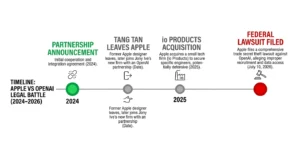
| June 2024 | Apple + OpenAI announce ChatGPT integration partnership |
| 2024 | Tang Tan leaves Apple after 24 years, joins io Products with Jony Ive |
| 2025 | OpenAI acquires io Products for $6.5 billion |
| January 2026 | Chang Liu leaves Apple for OpenAI, allegedly keeps laptop |
| February 2026 | Apple first contacts OpenAI about potential theft — no response |
| May 2026 | Bloomberg reports OpenAI considering legal action against Apple for breach of contract |
| July 10, 2026 | Apple files federal lawsuit against OpenAI, Tang Tan, Chang Liu, io Products |
The Jony Ive Connection — Why io Products Matters
The involvement of io Products — and by extension, Jony Ive — adds another layer to an already extraordinary story.
io Products is a hardware design firm acquired by OpenAI last year that was co-founded by Apple’s former design boss Jony Ive. Ive, who spent decades at Apple and is widely credited as the designer behind the modern iPhone, iPad, and MacBook, left Apple in 2019 and began collaborating with OpenAI in 2023.
The suit does not name Ive as a defendant, nor does it accuse him of wrongdoing. But io Products is named in the complaint, and the company’s role in OpenAI’s hardware ambitions is central to the lawsuit’s narrative.
In April, industry analyst Ming-Chi Kuo suggested this device could be a smartphone that would rely on AI agents instead of apps. If true, it would be one of the largest threats to Apple’s core hardware business to date.
What OpenAI Said — The Response
OpenAI’s response was brief and firm. “We have no interest in other companies’ trade secrets. We remain focused on building innovative technology that empowers people everywhere,” a representative for OpenAI said in a statement.
The company has not provided a detailed response to the specific allegations in the complaint. That is standard practice for early-stage litigation — detailed rebuttals come through formal legal filings rather than press statements.
What is significant about OpenAI’s situation is the timing. The suit could also complicate OpenAI’s plans to go public soon in a massive, hotly anticipated IPO. A federal trade secret lawsuit from Apple — one of the most litigious and well-resourced companies in the world — is exactly the kind of legal liability that complicates IPO processes and investor relationships.
What Apple Is Asking For
Apple’s complaint seeks three specific remedies:
- Injunctive relief — a court order barring OpenAI from using or disclosing Apple’s trade secrets
- Return of materials — requiring OpenAI to return any confidential Apple materials in its possession
- Preservation of evidence — requiring OpenAI to preserve all evidence related to the alleged scheme
The last point is particularly significant. By taking the case to court, Apple will have an opportunity to learn more about the extent of the alleged operation through the legal discovery process. Apple’s own complaint acknowledges that “this is the tip of the iceberg” — the lawsuit itself is partly a mechanism to find out how deep the alleged theft goes.
What This Means for the Apple-OpenAI Partnership
The partnership announced in June 2024 — integrating ChatGPT into Apple Intelligence across iPhone, iPad, and Mac — has not been officially terminated. Apple didn’t comment on whether the lawsuit will affect the partnership with OpenAI, which includes the integration of ChatGPT into Apple Intelligence.
The practical reality is that two companies cannot easily maintain a deep product integration partnership while one is suing the other for systematic trade secret theft. The discovery process alone — where each side gains access to the other’s internal communications and documents — creates confidentiality tensions that make continued close collaboration extremely difficult.
The lawsuit also represents a breakdown in the relationship between the two companies. In May, Bloomberg reported that OpenAI was considering legal action against Apple, potentially alleging breach of contract over claims that Apple had not sufficiently integrated and promoted OpenAI’s products across its devices. What started as a partnership dispute has now escalated to federal court on both sides.
The Bigger Picture — AI Hardware and the Talent War
This lawsuit is the most dramatic manifestation of a broader pattern that has been building throughout 2025 and 2026 — the aggressive competition for AI hardware talent.
OpenAI has aggressively poached top current and former Apple leadership and engineering talent, primarily to build a dedicated hardware division. According to a CNN count of LinkedIn profiles, OpenAI has recently hired at least ten engineers who joined the AI company directly from Apple.
The competitive stakes are enormous. OpenAI is rumored to be developing its first hardware product, which would likely compete with the iPhone. If the device described by Ming-Chi Kuo — an AI-native smartphone that relies on agents instead of apps — reaches the market, For a full comparison of how current smartphones compare, our guide on iPhone 17 vs Samsung Galaxy S26 shows how the landscape looks before OpenAI enters the hardware market. it represents an existential competitive threat to Apple’s core business. That context explains why Apple’s legal language is as aggressive as it is. This is not a routine IP dispute. It is a lawsuit filed by a company that believes its primary competitor is being built on stolen foundations.
For anyone following how AI tools and platforms are evolving in 2026, this lawsuit signals a new phase of competition — one where the AI capabilities you use on your phone and devices are being built, and fought over, at the highest levels. If you want to understand how AI tools are genuinely creating income opportunities independent of these corporate battles, our guide on how to make money with AI tools in 2026 covers the practical picture. And if you are considering which smartphone ecosystem to invest in given the uncertainty this lawsuit creates around Apple and OpenAI’s relationship, our guide on the best smartphones under 300 dollars in 2026 covers your options across both platforms.
The Mistakes Most People Are Making About This Story
The first mistake is treating this as just another corporate lawsuit. Trade secret cases between tech companies are common. A trade secret case where Apple accuses the most prominent AI company in the world of systematic theft at the Chief Hardware Officer level — coordinated across recruiting processes, exit interviews, and supplier relationships — is not common. The scale and specificity of the allegations make this qualitatively different from a routine IP dispute.
The second mistake is assuming the ChatGPT-Apple partnership is definitely over. Apple has not terminated the integration, and both companies have financial incentives to maintain it regardless of the litigation. Lawsuits and business relationships coexist in Silicon Valley with uncomfortable frequency. Whether the partnership survives depends on how the litigation develops and whether a settlement is reached.
The third mistake is ignoring what this tells us about OpenAI’s hardware ambitions. The alleged behaviour described in Apple’s complaint — recruiting Apple’s hardware chief, conducting “show and tell” sessions with Apple components, approaching Apple’s manufacturing partners — reveals an organisation building hardware capabilities at a pace that, according to Apple, required shortcuts. Understanding OpenAI’s hardware timeline is now a significant open question.
The fourth mistake is underestimating the IPO impact. OpenAI’s anticipated IPO is one of the most watched financial events in the tech industry. A federal trade secret lawsuit from Apple — with discovery rights that give Apple access to OpenAI’s internal communications — creates legal and reputational complexity that investors and underwriters will need to evaluate carefully.
For context on how Meta is facing similar AI challenges right now, our guide on Zuckerberg admitting Meta’s AI is not working covers the parallel story in detail.
What Comes Next
The immediate next steps in the litigation are Apple seeking preliminary injunctive relief — attempting to get a court order preventing OpenAI from continuing to use the allegedly stolen information while the case proceeds. OpenAI will file its response and almost certainly challenge the factual basis of the complaint.
The discovery process that follows — potentially months away — is where the real revelations will come. Apple has stated in its complaint that it lacks visibility into what has happened at OpenAI. Discovery will change that.
Whether this case reaches trial, settles, or results in a negotiated resolution to the broader Apple-OpenAI relationship dispute is impossible to predict. What is certain is that the outcome will shape how the two most important AI-adjacent consumer hardware companies interact — and compete — for years to come.
The partnership between Apple and OpenAI that Tim Cook and Sam Altman celebrated together in 2024 looks very different today. What comes next will be one of the most closely watched stories in technology for the rest of 2026 and beyond.
