

Here is a number that should make every student sit up straight.
Global student AI usage jumped from 66% in 2024 to 92% in 2025. By the start of 2026, an estimated 86% of all students in higher education are using AI as their primary research and brainstorming partner. And a 2025 Harvard University physics study found that students using AI tutors learned more than twice as much in less time compared to those in traditional active-learning classrooms.
Twice as much. In less time.
That is not a marginal improvement. That is a structural shift in how learning works — and the students who understand which AI tools actually help them learn versus which ones just generate text they cannot defend in an exam are the ones pulling ahead right now.
Here is the honest picture: most students are using AI tools the wrong way. They paste an essay prompt into ChatGPT, submit what comes back, and wonder why their grades are not improving. The students who actually benefit from AI tools in 2026 are using them as thinking partners — to understand material more deeply, study more efficiently, and produce work that is genuinely their own.
Here are the best AI tools for students in 2026 — tested, honest, and organized by what you actually need them to do.
Why AI Tools for Students Are Different in 2026
Three years ago, AI tools for students meant grammar checkers and basic plagiarism detectors. In 2026, the category spans research assistants that cite academic sources, math solvers that show step-by-step working, note-taking tools that transcribe and summarize lectures in real time, and writing aids that improve your own drafts rather than replacing them.
The shift that matters most is quality. The best AI tools for students in 2026 are genuinely useful for learning — not just for producing output. They explain reasoning, quiz you on material, catch errors in your logic, and adapt to your specific subject and level. Used correctly, they are the most powerful study resource any student has ever had access to.
The caveat is real: used incorrectly — as essay generators or homework shortcut machines — they produce graduates who cannot think through a hard problem without assistance. The tools in this guide are picked because they help you understand, retain, and apply knowledge. Not because they can do your work for you.
Tool 1 — ChatGPT (Best All-Around Study Partner)
ChatGPT remains the most widely used AI tool among students in 2026, and for good reason — it is the most versatile general-purpose study assistant available.
Where ChatGPT genuinely excels for students is concept explanation. Ask it to explain the difference between monetary and fiscal policy, break down how photosynthesis works at the molecular level, or walk you through the logic of a proof you are stuck on — and it delivers clear, patient, step-by-step explanations that adapt to your level if you ask it to. This is where the tool earns its reputation.
The free version of ChatGPT handles general studying, essay planning, and concept clarification well. The paid version — ChatGPT Plus at $20 per month — adds access to GPT-4o, which handles longer documents, more complex reasoning, and code interpretation significantly better than the free tier.
The honest caveat: ChatGPT’s training data has a knowledge cutoff, which means it can be confidently wrong about recent events or highly specific academic facts. Always cross-check anything factual against your textbook or a verified academic source before including it in submitted work. Use it to understand — verify before you cite.
Best for: Explaining concepts, generating practice questions, summarizing chapters, brainstorming essay arguments, and debugging code. How to use ChatGPT to make money
Realistic time saving: Students using ChatGPT for concept explanation and practice question generation report saving 2 to 4 hours per week on average across their coursework.
Tool 2 — Grammarly (Best for Writing Quality)
Grammarly is the second most used AI tool among students globally — and unlike most tools on this list, it focuses entirely on making your own writing better rather than generating new writing for you.
In 2026, Grammarly has expanded significantly beyond grammar and spelling corrections. Its AI-powered suggestions now cover clarity, tone, conciseness, sentence variety, and academic style. For students writing essays, reports, and research papers, the difference between a first draft and a Grammarly-reviewed draft is consistently meaningful.
The free version of Grammarly catches grammar, spelling, and basic punctuation errors — which is genuinely useful and genuinely free. Grammarly Premium adds style suggestions, clarity rewrites, and plagiarism detection, which is worth considering for students writing substantial academic work regularly.
What makes Grammarly the right tool for students specifically — rather than just any writing tool — is that it improves your writing without replacing your voice. The suggestions are exactly that: suggestions. You learn from them over time, which means students who use Grammarly consistently tend to become better writers, not more dependent ones.
Best for: Essays, research papers, lab reports, emails to professors, and any written assignment where quality and clarity matter.
Honest note: Grammarly’s plagiarism checker compares your text against web content — not against academic databases like Turnitin uses. Do not rely on it as your only plagiarism check for submitted academic work.
Tool 3 — Wolfram Alpha (Best for STEM Subjects)
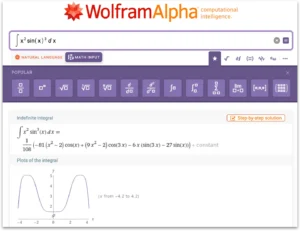
For students in mathematics, physics, chemistry, engineering, and statistics, Wolfram Alpha is the most powerful AI tool available — and it does something that general chatbots consistently fail at: it shows correct, verifiable step-by-step working.
Ask ChatGPT to solve a differential equation and you might get the right answer or you might not — and you often cannot tell which. Ask Wolfram Alpha and you get the correct solution with every step shown, the reasoning explained, and the result verifiable. For STEM students, that reliability is not optional — it is the entire point.
Wolfram Alpha free handles a substantial range of mathematical queries. The Pro plan — available at a student discount rate — shows complete step-by-step solutions across calculus, statistics, physics, chemistry, and engineering problems. For any student whose coursework involves significant quantitative work, Wolfram Alpha Pro is one of the most cost-effective academic tools available.
A 2025 Harvard study confirmed that students using AI tutoring tools for STEM subjects learned more than twice as fast as those using traditional methods alone — and Wolfram Alpha is the tool most consistently cited in that context for quantitative subjects.
Best for: Calculus, algebra, statistics, physics problems, chemistry equations, data analysis, and any subject where correct step-by-step working matters more than general explanation.
Tool 4 — Notion AI (Best for Organisation and Note-Taking)
Notion AI combines one of the most powerful note-taking and organisation platforms available with an integrated AI assistant that helps you work with your notes rather than just store them.
For students managing multiple subjects, deadlines, research sources, and project timelines simultaneously, Notion provides the structure. The AI layer adds the ability to summarise your own notes, generate study guides from your lecture transcripts, identify gaps in your research, and draft outlines based on the material you have already collected.
The workflow that works best for students: take notes in Notion during lectures and while reading, then use Notion AI to generate a concise summary and a set of practice questions from those notes at the end of each study session. This active recall approach — using AI to quiz you on material you just covered — is significantly more effective for retention than passive re-reading.
Notion AI is included in Notion’s paid plans, which start at a student-eligible price. The free plan includes the core note-taking and organisation features without AI assistance, which is still genuinely useful as a standalone study organisation tool.
Best for: Organising coursework, summarising lecture notes, building study guides, managing research for long-form papers, and tracking deadlines across multiple subjects. Best AI Tools for Freelancers
Tool 5 — Perplexity AI (Best for Research)
Perplexity AI is the tool that solves one of the biggest problems with using AI for academic research: citation.
When you ask ChatGPT a research question, it gives you an answer — but it does not tell you where the information came from, and it sometimes confidently generates sources that do not exist. Perplexity AI answers research questions with cited sources attached to every claim, drawn from real web pages and academic sources that you can click through and verify.
For students doing literature reviews, researching essay topics, or trying to find credible sources quickly, Perplexity is dramatically more useful than a general chatbot. The Pro version adds access to academic databases and more advanced search capabilities — relevant for students at universities where access to academic literature matters.
The honest limitation: Perplexity’s sources are web-based, which means they skew toward accessible online content rather than paywalled academic journals. For rigorous academic research at postgraduate level, you still need access to your university library’s database. But for undergraduate research, finding credible starting points, and verifying general claims quickly, Perplexity is the most reliable AI research tool available in 2026.
Best for: Initial research for essays, finding and verifying sources, exploring unfamiliar topics, and fact-checking claims before including them in academic work.
Tool 6 — Otter.ai (Best for Lecture Transcription)
Otter.ai transcribes lectures, seminars, and study group discussions in real time — which solves one of the most persistent problems in student life: the gap between what was said in a lecture and what actually ended up in your notes.
The tool records audio and produces a searchable, timestamped transcript that you can review, highlight, and export. For students who process information better by reading than by listening — or who simply cannot write fast enough to capture everything in a fast-paced lecture — Otter.ai is genuinely transformative.
The free plan handles 300 minutes of transcription per month, which covers most students’ lecture load comfortably. The paid plan adds unlimited transcription, which is worth considering for students with heavy seminar schedules or who record study group sessions regularly.
The honest caveat: Otter.ai’s accuracy depends on audio quality and accent clarity. In a lecture hall with poor acoustics or a lecturer with a strong accent, transcription accuracy drops. Always review the transcript rather than assuming it is error-free.
Best for: Transcribing lectures and seminars, capturing study group discussions, reviewing material after class, and supplementing notes taken during fast-paced lectures.
Tool 7 — Quizlet AI (Best for Memorisation and Exam Preparation)
Quizlet has been the go-to flashcard platform for students for years — and in 2026, its AI integration makes it significantly more powerful for exam preparation than its earlier versions.
Quizlet AI can generate flashcard sets from any text you paste in — lecture notes, textbook chapters, essay prompts — in seconds. It then uses spaced repetition algorithms to surface the cards you are weakest on more frequently, which is the study method with the strongest evidence base for long-term retention. The distinction between Quizlet and a general AI chatbot for memorisation is that Quizlet actively tests you — not just summarises for you.
For language students, Quizlet AI is particularly strong. Vocabulary acquisition is one of the areas where AI-assisted spaced repetition produces measurable results fastest. Students using Quizlet AI for vocabulary report covering three to four times more material in the same study time compared to traditional flashcard methods.
Best for: Exam preparation across all subjects, vocabulary acquisition for language students, memorising definitions and key terms, and building active recall into daily study habits.
| AI Tool | Best For | Free Plan | Paid Plan | Ideal Student |
|---|---|---|---|---|
| ChatGPT | General studying & concept explanations | Yes | $20/month | Most students |
| Grammarly | Writing improvement | Yes | Premium available | Essay writers |
| Wolfram Alpha | STEM subjects | Yes | Pro available | Math & science students |
| Notion AI | Notes & organisation | Limited | Paid plans | Multi-subject students |
| Perplexity AI | Research & citations | Yes | Pro available | Research-heavy courses |
| Otter.ai | Lecture transcription | Yes | Paid plans | Lecture-based learning |
| Quizlet AI | Memorisation & exam prep | Yes | Premium available | Exam-focused students |
The Honest Guide to Using AI Tools Without Compromising Your Education
Here is what the statistics do not tell you — and what most AI tools guides will not say.
The students who benefit most from AI tools in 2026 are the ones using them to accelerate understanding, not to bypass it. Using ChatGPT to explain a concept you are struggling with and then working through practice problems yourself is a legitimate and highly effective study method. Using ChatGPT to write an essay you submit as your own is academic dishonesty — and increasingly detectable.
Most universities in 2026 now distinguish between using AI as a study aid — which is widely permitted — and submitting AI-generated work as your own without disclosure — which is not. Check your institution’s academic integrity policy before using any AI writing tool on graded work. When in doubt, cite AI assistance in your methodology section.
The students who will look back on 2026 as the year that changed their academic performance are not the ones who found the best AI shortcut. They are the ones who learned how to use AI tools to understand material twice as fast, retain it more effectively, and produce work that reflects genuine comprehension. If you want to understand how the same AI tools that help students study can also generate income, our guide on how to make money with AI tools in 2026 shows how these skills translate directly into freelancing and digital income opportunities. And if you are thinking about building a freelancing career alongside your studies.
What Comes Next for AI Tools in Education
The AI tools available to students in 2026 are already more powerful than anything available three years ago — and they are still improving. Personalised AI tutors that adapt to individual learning styles, real-time feedback on academic writing, and AI-powered research assistants that search academic databases directly are all either available now or arriving within the next 12 months.
The students who build the habit of using AI tools strategically — as thinking partners, not answer machines — will have a compounding advantage over the next four years of their education and into their careers. The tools are available to everyone. How you use them is what makes the difference.
Start with one tool that addresses your biggest current study challenge. Give it four weeks of consistent use. Then add the next one.
What is the best AI tool for students in 2026?
It depends on what you need. For general studying and concept explanation, ChatGPT is the most versatile. For STEM subjects and math, Wolfram Alpha is the most reliable. For writing improvement, Grammarly.
Which AI tools for students are completely free?
Several strong options are free. ChatGPT’s free version handles most general study needs. Grammarly’s free plan catches grammar and spelling errors.
What is the best free AI tool for writing essays?
Grammarly is the best free AI tool for improving essays you have already written — it catches grammar errors, improves clarity, and suggests better phrasing without replacing your voice.