
You have probably heard the word Web3 more times in the last twelve months than in the previous five years combined.
It shows up in conversations about crypto, gaming, AI, finance, and social media. Tech companies mention it in press releases. Investors throw billions at it. Politicians debate regulating it. And most people who encounter the term walk away with the same question: what actually is Web3, and why does it matter to me?
The honest answer is that Web3 is one of the most genuinely significant shifts in how the internet works — and also one of the most overhyped, misunderstood, and jargon-laden topics in technology. Separating what is real from what is marketing has become a full-time job.
The Web3 market is valued at $10.2 billion in 2026 and is projected to contribute $1.1 trillion to global GDP by 2032. These are not speculative numbers — they reflect institutional investment, real applications, and genuine adoption happening right now across finance, gaming, healthcare, and supply chains.
Here is the complete beginner’s guide to Web3 in 2026 — no jargon, no hype, just a clear explanation of what it is, how it works, and why it matters.
What Is Web3 — The Simple Explanation
Web3 is the next version of the internet — one where you own your data, your digital assets, and your online identity instead of renting them from corporations.
To understand why that matters, you need to understand what came before it.
Web1 was the read-only internet of the 1990s. Static pages, basic information, no interaction. You could read content but not create or interact with it.
Web2 is the internet most people use today — the read-write internet. Social media, streaming, cloud storage, e-commerce. The problem is that Web2 is controlled by a small number of massive corporations. Google owns your search history. Facebook owns your social graph. Spotify owns your playlists. You use these services for free — but the price is your data, your attention, and your digital identity.
Web3 is the read-write-own internet. Blockchain technology enables users to actually own their digital assets, control their data, and participate in platforms without a central corporation extracting value from everything they do.
The simplest possible definition:
Web3 = The internet where you own your stuff.
How Does Web3 Actually Work?
Web3 is built on three core technologies that work together:
Blockchain
A blockchain is a digital ledger — a record of transactions and data — that is distributed across thousands of computers simultaneously instead of stored on one company’s server.
Because thousands of computers hold identical copies of the ledger, no single entity can alter, delete, or control the data. When you record something on a blockchain, it stays there permanently and verifiably. This is the foundation of ownership in Web3 — if your asset is recorded on the blockchain, nobody can take it from you without your permission.
Smart Contracts
Smart contracts are self-executing programs stored on a blockchain that automatically carry out agreements when specific conditions are met.
Think of a smart contract like a vending machine. You put in money, select your item, and the machine automatically dispenses it — no cashier, no middleman, no possibility of the machine keeping your money without delivering the product. Smart contracts work the same way for digital agreements: no bank, no lawyer, no platform taking a cut of every transaction.
Decentralised Applications (dApps)
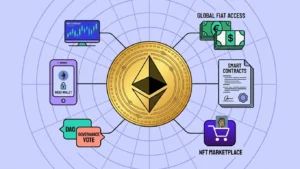
Decentralised applications are software programs that run on blockchain networks instead of centralised servers. Unlike traditional apps — where a company controls the servers and can shut down the app, change the rules, or ban users at any time — dApps run on blockchain infrastructure that no single entity controls.
In 2026, there are over 15.4 million active addresses interacting with Web3 applications globally — a number that has grown significantly from previous years.
Web1 vs Web2 vs Web3 — The Key Differences
| Feature | Web1 | Web2 | Web3 |
|---|---|---|---|
| Era | 1990s — 2004 | 2004 — present | 2020 — present |
| Type | Read only | Read + Write | Read + Write + Own |
| Control | Decentralised | Centralised corporations | Decentralised users |
| Data ownership | N/A | Platform owns your data | You own your data |
| Monetisation | None for users | Platform profits from users | Users earn directly |
| Examples | Early websites | Google, Facebook, YouTube | Ethereum, Solana, dApps |
| Payment | N/A | Credit cards, PayPal | Crypto, stablecoins, tokens |
What Can You Actually Do With Web3 in 2026?
This is where most Web3 explanations fail — they describe the technology without explaining what you can do with it today. Here is what is actually happening in 2026:
Decentralised Finance (DeFi)
DeFi replaces traditional banking with blockchain-based alternatives. Lending, borrowing, earning interest, and trading assets — all without a bank, without an account application, and without a bank’s fees or restrictions.
The DeFi market is projected to grow from $20.48 billion in 2024 to $231.19 billion by 2030 — a 53.7% compound annual growth rate. In 2026, DeFi is no longer experimental. It is increasingly structured, regulated, and used by both individuals and institutions.
Real-World Asset Tokenisation
This is the most significant Web3 development of 2026. Physical assets — real estate, commodities, government bonds, art, and private equity — are being converted into blockchain tokens. Each token represents ownership of a fraction of the underlying asset.
The practical implication is dramatic. A retail investor can now own a fraction of a commercial property in Dubai, a US Treasury bond, or a piece of fine art — assets previously accessible only to institutional investors with millions to invest. The global market for tokenised assets is projected to exceed $16 trillion by 2030, with institutions including BlackRock, JPMorgan, and Goldman Sachs already launching tokenised fund products.
Web3 Gaming
Web3 gaming gives players genuine ownership of in-game assets. In traditional gaming, the skins, weapons, characters, and items you purchase exist on a company’s server — and if the game shuts down or the company changes its policies, those assets disappear. In Web3 games, your assets exist on the blockchain. You own them. You can sell them, trade them, or take them to other compatible games.
Stablecoin transactions in Web3 games surged 2 to 3 times in 2026, with indie developers now making up over 70% of Web3 gaming activity. Even traditional gaming giants — with PlayStation hinting at blockchain integration — are exploring Web3 features.
Decentralised Identity
Decentralised identity gives you control over your digital identity instead of delegating it to platforms. Instead of logging into every website with a Google or Facebook account — giving those companies data about where you go and what you do — Web3 identity systems let you authenticate yourself directly from your own wallet without any intermediary.
The self-sovereign identity market has grown from $3 to 6 billion in 2025 to projections of $6 to 7 billion in 2026 — heading toward trillion-dollar valuations as the technology matures.
SocialFi
SocialFi combines social media with Web3 ownership. On traditional platforms, creators generate content that the platform monetises through advertising — and creators receive a fraction of the value they create. SocialFi platforms give creators direct ownership of their audience relationships and revenue, with token-based monetisation that eliminates the platform as a middleman.
Web3 vs Crypto — What Is the Difference?
This is one of the most common points of confusion — and clarifying it makes Web3 significantly easier to understand.
Cryptocurrency is a digital currency secured by cryptography and recorded on a blockchain. Bitcoin and Ethereum are cryptocurrencies. Crypto is one application built on blockchain technology.
Web3 is the broader vision of a decentralised internet — of which cryptocurrency is one component. Web3 includes DeFi, NFTs, dApps, decentralised identity, smart contracts, and the entire infrastructure of a user-owned internet. Crypto is to Web3 what email is to the internet — a specific application built on a larger infrastructure.
You can use Web3 applications without owning cryptocurrency in some contexts — and you can own cryptocurrency without engaging with Web3 at all.
Web3 in 2026 — What Has Actually Changed
The Web3 narrative has shifted significantly since the hype cycles of 2021 and 2022. Here is what is genuinely different in 2026:
Institutional adoption is real. BlackRock, JPMorgan, and Goldman Sachs are no longer observing from the sidelines — they are actively launching blockchain-based products. This level of institutional participation was theoretical two years ago.
Regulation has matured. Web3 either integrates into regulatory frameworks or remains niche — and in 2026, the leading projects are choosing integration. A new class of Web3 products is being built with compliance built in from day one, making them significantly more scalable and sustainable than the earlier generation of permissionless experiments.
Infrastructure has improved. Cross-chain interoperability — the ability to move assets across different blockchain networks — has become a standard feature rather than an engineering challenge. Users can now interact with multiple blockchains from a single interface, significantly reducing the complexity that limited mainstream adoption in earlier years.
AI and Web3 are converging. The combination of artificial intelligence and blockchain creates new categories of applications — decentralised AI networks, on-chain data economies, and AI-assisted smart contract execution. This convergence increases the productivity of decentralised applications by 30% according to current data. If you want to understand how AI tools are creating income opportunities that intersect with Web3 applications, our guide on how to make money with AI tools in 2026 covers the full range of methods available right now.
How Does Web3 Make Money — For Regular People
This is the question most beginner guides skip — and the most practically relevant one for most readers.
Participating in DeFi: Lending your cryptocurrency on DeFi platforms earns interest rates that typically exceed traditional savings accounts significantly. Providing liquidity to decentralised exchanges earns trading fees. These are not risk-free strategies — cryptocurrency values fluctuate — but they represent genuine income mechanisms unavailable in Web2.
Play-to-earn gaming: Web3 games reward players with tokens and in-game assets that have real monetary value. Players earn by completing quests, winning battles, and contributing to game ecosystems. The most successful Web3 games have created sustainable earning economies for players in markets where traditional employment opportunities are limited.
Creating and selling NFTs: Non-fungible tokens represent unique digital ownership. Artists, musicians, and content creators use NFTs to sell their work directly to buyers without platform intermediaries. Creators also receive royalties automatically on every secondary sale — something impossible in traditional digital content markets.
Web3 freelancing: Web3 roles pay 20 to 40% more than equivalent Web2 positions, with remote work standard and token-based compensation packages offering equity upside. Smart contract developers, blockchain auditors, Web3 community managers, and tokenomics designers are all in significant demand with talent supply lagging behind. If you want to understand which freelancing skills are commanding the highest rates in 2026 — including Web3-adjacent skills — our guide on the Top Freelancing Skills in 2026 covers the most in-demand capabilities in detail.
The Honest Limitations of Web3 in 2026
Web3 is real — but it is not perfect. Here are the limitations that matter for anyone considering engaging with it:
Complexity remains a barrier. Using Web3 applications still requires understanding concepts — wallets, private keys, gas fees, seed phrases — that have no equivalent in Web2. Losing your private key means permanently losing access to your assets. This is genuine user responsibility that most people are not accustomed to from Web2 platforms where password recovery is standard.
Regulation is still evolving. The regulatory environment for Web3 varies dramatically by country and is still being defined in most jurisdictions. What is legal and compliant in one market may not be in another. Anyone engaging with Web3 financially should understand the regulatory context in their specific location.
Scams remain prevalent. The combination of irreversible transactions, pseudonymous participants, and valuable assets makes Web3 a target for sophisticated fraud. Fake projects, rug pulls, phishing attacks on wallets, and social engineering are real risks that require careful due diligence before engaging with any Web3 application or investment.
Not everything called Web3 is decentralised. Marketing has adopted the Web3 label for products that are not meaningfully decentralised. Evaluating actual decentralisation — who controls the servers, who can change the rules, who holds the private keys — requires investigation beyond what a project’s marketing materials reveal.
How to Get Started With Web3 in 2026
If you want to explore Web3 beyond reading about it, here is the practical starting point:
- Set up a non-custodial wallet — MetaMask is the most widely used Ethereum wallet. A non-custodial wallet means you hold your own private keys rather than trusting a platform with them.
- Buy a small amount of Ethereum — Ethereum is the most widely used blockchain for Web3 applications. A small amount — $20 to $50 — is enough to interact with most dApps and understand how transactions work.
- Explore a dApp — Uniswap for decentralised exchange, OpenSea for NFTs, or Aave for DeFi lending are the most established starting points.
- Learn about seed phrases — Your seed phrase is the master key to your wallet. Write it down on paper, store it securely, and never share it with anyone or enter it on any website. This is the single most important security practice in Web3.
If you want to understand how Web3 and blockchain fit into the broader tech landscape — including how gaming laptops and devices support Web3 gaming — our guide on the best gaming laptops under 500 dollars in 2026 covers the hardware that handles Web3 gaming applications well.
What Comes Next for Web3
The Web3 trajectory in 2026 is clear. The speculative era is giving way to infrastructure, regulation, and real-world application. The projects that will matter in 2028 are not the ones promising the highest returns — they are the ones building the foundational layers that make Web3 usable for people who have never heard the term blockchain.
The Web3 economy is projected to contribute $1.1 trillion to global GDP by 2032. That number will be built not on speculation but on tokenised assets, decentralised finance, verifiable identity, and applications that solve problems people actually have.
Whether you engage with Web3 as a user, a creator, a developer, or simply an informed observer — understanding what it is and how it works puts you ahead of the majority of people who have heard the word without understanding what it means.
The internet is being rebuilt. That process started years ago and it is accelerating in 2026.