Quantum Computing in 2026: The Best Guide to Understanding It
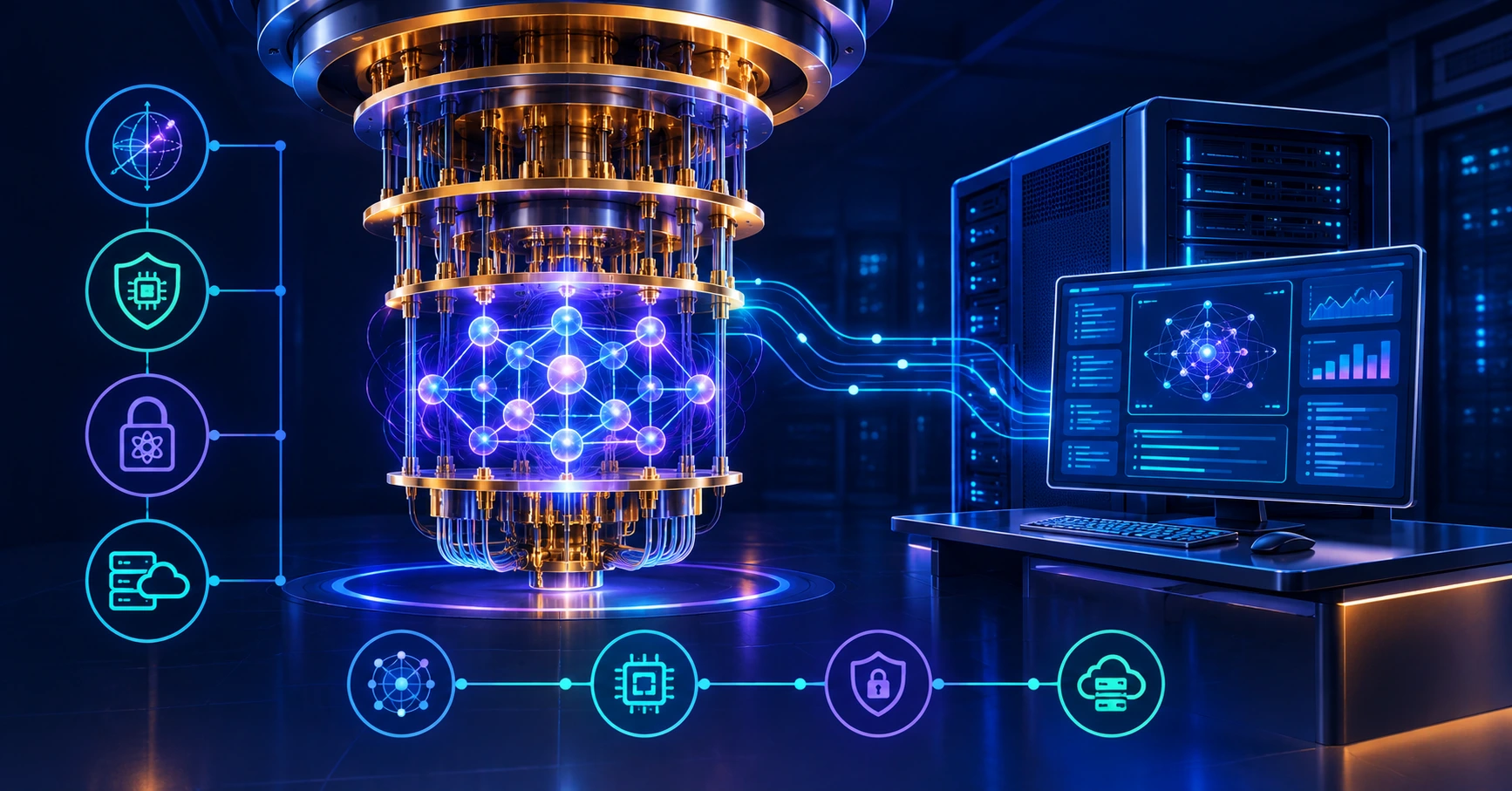
Quantum computing uses the behavior of atoms, electrons, and photons to process information in ways classical computers cannot. Instead of ordinary bits that are either 0 or 1, quantum computers use qubits, which can exist in a combination of both states before measurement.
The practical value is not that quantum computers will replace laptops or phones. They are best understood as specialized accelerators for certain complex problems—especially chemistry, materials science, optimization, and cryptography—working alongside classical computers. 1067
What Quantum Computing Really Means
A classical computer stores information in bits: each bit is either 0 or 1. A quantum computer uses qubits, which can be in a superposition of 0 and 1 until measured. NIST explains that measuring a qubit forces it to collapse into either 0 or 1. 1067
Quantum computers also use entanglement, a quantum connection between qubits. When qubits are entangled, their states are correlated, so measuring one can tell you something about the other even when they are far apart. 1068
| Concept | Classical computing | Quantum computing |
|---|---|---|
| Basic unit | Bit: 0 or 1 | Qubit: 0, 1, or a superposition of both |
| Information handling | Deterministic logic | Probabilistic quantum states |
| Key phenomenon | Transistors and logic gates | Superposition and entanglement |
| Best use | Everyday apps, databases, web, AI training | Certain chemistry, optimization, and cryptographic problems |
| Relationship | Works alone | Needs classical computers to control, schedule, and interpret results |
NIST notes that two qubits can represent a superposition of four possible bit combinations, three qubits can represent eight, and four can represent sixteen. But this does not mean a quantum computer simply checks every answer at once; useful computation requires carefully designed algorithms, entanglement, and error control. 1067
The Honest Truth About Quantum Computing
Quantum computers are not magic. They are extremely sensitive machines. Heat, electromagnetic noise, vibration, and even cosmic rays can disturb qubit states, a problem called decoherence. 1067
The honest truth is that today’s quantum computers are still noisy and limited. They cannot yet replace classical computers, run a “quantum phone,” or instantly solve every difficult problem. IBM explicitly says quantum computers will not replace classical computers and are not universally better for all tasks. 1091
The field’s biggest challenge is error correction. A useful quantum computer needs many physical qubits to create reliable logical qubits, because individual qubits make errors. IBM says its 2026 roadmap includes prototyping a real-time error-correction decoder, a key step toward scalable fault-tolerant quantum computing. 1070
How Quantum Computers Work
A quantum program generally follows this process:
-
A classical computer prepares the problem and translates it into quantum instructions.
-
Qubits are initialized and placed into superposition.
-
Quantum gates manipulate the qubits and create entanglement.
-
The quantum processor runs the circuit.
-
Measurement produces classical results.
-
A classical computer processes, repeats, or interprets the output. 1067
IBM describes this as a hybrid workflow: classical systems prepare inputs, compile circuits, schedule jobs, and post-process results, while the quantum processing unit executes only the quantum portion. 1091
Why Quantum Computing Matters
Quantum computing matters because some problems are fundamentally hard for classical machines. Simulating molecules, designing new materials, and modeling quantum systems can require enormous classical resources because nature itself behaves quantum mechanically.
Research identifies several promising application areas:
-
Chemistry and materials science: Simulating molecules, catalysts, batteries, and new materials.
-
Optimization: Routing, scheduling, logistics, portfolio construction, and supply-chain problems.
-
Cryptography: Breaking some current public-key encryption and motivating quantum-safe cryptography.
-
Machine learning: Exploring quantum-enhanced models, though practical advantage is not yet established.
-
Finance: Risk analysis, portfolio optimization, and complex simulations. 1089
The most credible near-term progress is in hybrid quantum-classical workflows. A review of business applications notes that current value is likely to come from hybrid systems and application-specific algorithms, rather than from quantum computers replacing classical infrastructure. 1089
Quantum Error Correction: The Real Breakthrough
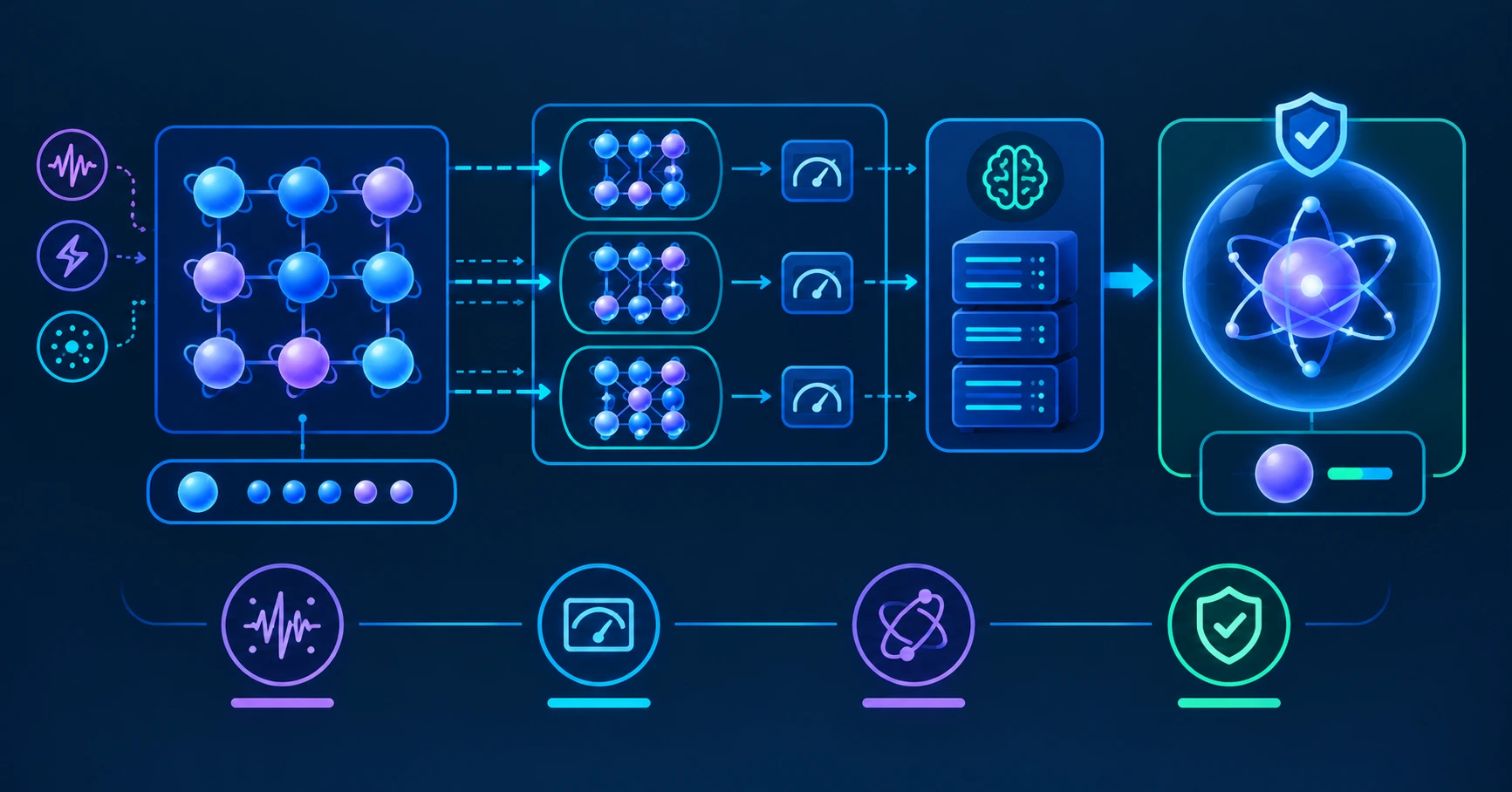
Quantum computers make errors because qubits are fragile. Quantum error correction protects information by encoding one logical qubit across many physical qubits, allowing some errors to be detected and corrected without destroying the quantum state. 1071
A logical qubit is not a physical object. It is an error-corrected unit of quantum information built from multiple physical qubits. This is why qubit count alone is misleading: a machine with many noisy physical qubits may be less useful than a smaller machine with better logical qubits. 1071
IBM’s 2026 roadmap says its Nighthawk platform is expected to run circuits with 7,500 gates in 2026 using up to three 120-qubit modules, with targets of 10,000 gates in 2027 and 15,000 gates in 2028. IBM also targets large-scale fault-tolerant quantum computing by 2029. 1070
Google’s Willow chip demonstrated below-threshold error correction: increasing the surface-code distance from 3×3 to 5×5 to 7×7 reduced logical error rates by factors of roughly 2 to 3 at each step. That was an important proof that scaling can reduce errors rather than amplify them. 1071
Quantum Computing and Cybersecurity
Quantum computing creates a serious future risk for today’s public-key cryptography. Algorithms such as RSA and elliptic-curve cryptography rely on mathematical problems that a sufficiently powerful quantum computer could break using Shor’s algorithm. 1068
That does not mean all encryption is immediately broken. Symmetric encryption and many hash functions are less directly threatened, but public-key systems used for secure websites, digital signatures, and key exchange need migration to quantum-resistant alternatives. 1100
NIST finalized three post-quantum cryptography standards in 2024:
| Standard | Algorithm | Purpose |
|---|---|---|
| FIPS 203 | ML-KEM | General encryption and key establishment |
| FIPS 204 | ML-DSA | General-purpose digital signatures |
| FIPS 205 | SLH-DSA | Backup digital-signature method |
NIST says these standards are ready for implementation and encourages system administrators to begin transitioning as soon as possible. 1082 The agency also identifies RSA, Diffie-Hellman, ECDSA, and EdDSA as quantum-vulnerable algorithms, while ML-KEM, ML-DSA, and SLH-DSA are designed to resist quantum attacks. 1100
What Quantum Computers Will Not Do
Quantum computing is surrounded by hype. These are the most important corrections:
-
They will not replace classical computers. Quantum systems need classical computers to operate.
-
They will not make every calculation faster. They help only certain problem types.
-
They do not simply try every answer at once. Measurement collapses superpositions, so algorithms must amplify correct answers.
-
More qubits do not automatically mean more power. Error rates, connectivity, gate fidelity, and error correction matter more.
-
They are not the same as AI. Quantum computing and AI are separate technologies, though they may eventually work together in hybrid systems. 1091
IBM says quantum-centric supercomputing combines quantum and classical systems, with each handling the tasks it is best suited for. 1092
How to Think About Quantum Readiness
For most people and small businesses, quantum computing is not something to buy today. The practical action is cryptographic readiness: identify where your systems use RSA, ECC, or other vulnerable public-key cryptography, and plan a migration to post-quantum standards.
-
Inventory systems that use public-key cryptography.
-
Identify long-lived sensitive data that could be harvested now and decrypted later.
-
Prioritize data that must remain confidential for years.
-
Work with software and cloud vendors on PQC support.
-
Use hybrid migration approaches where possible.
-
Test performance, compatibility, and key-management changes.
-
Avoid waiting until quantum computers are commercially powerful.
NIST’s transition guidance proposes deprecating 112-bit-strength quantum-vulnerable algorithms after 2030 and disallowing them after 2035, with 128-bit-and-higher algorithms disallowed after 2035. 1100
The Mistakes That Keep People From Understanding Quantum Computing
The first mistake is believing quantum computers will replace classical computers. They will not. They are specialized machines that depend on classical systems for control, orchestration, and result processing. 1091
The second mistake is focusing only on qubit counts. A quantum computer with more physical qubits is not necessarily better if its error rate is high. Logical qubits and error correction are the more meaningful measures of progress. 1071
The third mistake is assuming quantum computers can solve every optimization or AI problem. Many claimed applications still require fault-tolerant machines with millions of logical qubits, which remain years away. 1089
The fourth mistake is treating “quantum advantage” as solved. Demonstrations can show speedups on narrow benchmarks, but practical advantage means outperforming classical methods on a useful real-world problem. IBM urges skepticism toward broad claims of quantum supremacy. 1092
The fifth mistake is delaying cryptographic migration. Even before large quantum computers exist, encrypted data can be collected now and decrypted later if stronger quantum machines arrive. That is why NIST says organizations should begin moving to post-quantum cryptography now. 1085
The Fastest Path to Quantum Readiness
For individuals: You do not need to buy a quantum computer. Keep software, browsers, and devices updated, and use strong passwords and multi-factor authentication.
For developers: Learn the basics of quantum algorithms, but focus first on post-quantum cryptography libraries and secure key management. Do not assume quantum computing will solve your application’s performance problems.
For businesses: Start a cryptographic inventory, identify long-lived sensitive data, and ask cloud and security vendors about ML-KEM and ML-DSA support. Build a migration plan before 2030.
For researchers: Focus on hybrid workflows, error correction, and problems where quantum methods have a clear theoretical advantage over classical alternatives.
For a broader view of emerging technology, see Eblowee’s guide to the best AI tools for freelancers.
What Comes Next
The next phase of quantum computing is not about replacing classical computers. It is about building reliable logical qubits, improving error correction, and connecting quantum processors with classical high-performance computing.
The most important milestone is fault tolerance: quantum systems that can run long, complex algorithms without being overwhelmed by noise. IBM, Google, Microsoft, and other companies are making progress, but useful, large-scale quantum advantage remains a future engineering challenge. 1070
The practical priority today is quantum-safe security. Organizations that protect long-lived data should begin migrating to post-quantum cryptography now.
The window to prepare for quantum computing is open right now — but it is not going to stay open forever.
One inventory. One migration plan. That is the formula.
What is quantum computing in simple terms?
Quantum computing is a type of computing that uses qubits instead of ordinary bits. A qubit can exist in a combination of 0 and 1 through superposition, and multiple qubits can become entangled. This allows quantum computers to approach certain complex problems differently from classical computers.
Will quantum computers replace classical computers?
No. Quantum computers are not expected to replace classical computers. They need classical systems to prepare inputs, control operations, schedule jobs, and interpret results. Quantum computers are best used for specific complex problems, not everyday tasks such as browsing, email, or word processing.
What is a qubit?
A qubit is the basic unit of quantum information. Unlike a classical bit, which is either 0 or 1, a qubit can exist in a superposition of both states until it is measured. Qubits can also become entangled with one another.
What is quantum error correction?
Quantum error correction protects fragile quantum information by encoding one logical qubit across many physical qubits. This lets a system detect and correct certain errors without destroying the quantum state. It is essential for building large-scale, fault-tolerant quantum computers.