
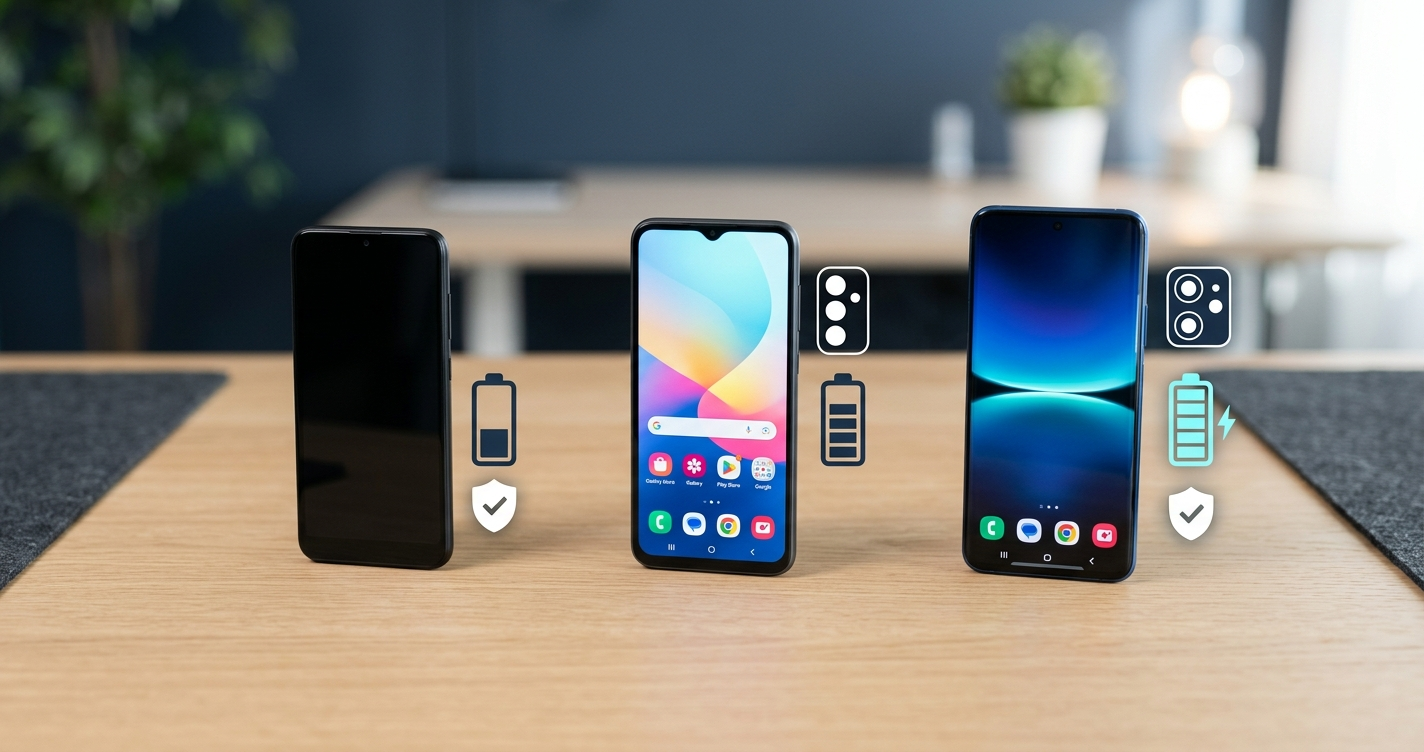
A phone advertised at a budget price can become a poor deal when its price rises or its software support is short. That matters right now: Google’s Pixel 10a, which launched at $499 in the U.S., is listed at $599 on Google’s store. The phone itself did not gain new hardware with that increase, so its value depends more than ever on whether you find it on sale.blog+1
The best budget phone depends on what you want most: reliable photos, long battery life, a low upfront price, or years of software updates. Below, I compare options at different prices and explain the trade-offs, so you can pick a phone that fits your budget—not just its marketing.
Why 2026 Is the Right Time to Buy Carefully
Budget phones have improved. You can now find large, high-refresh-rate screens, 5G, capable main cameras, and multi-year update promises at prices well below flagship territory. But “budget” covers very different phones: an under-$200 model prioritizes basics, while a phone near $500 may offer a stronger camera, display, or processor.
Prices have also become less predictable. The Pixel 10a’s U.S. list price rose by $100 to $599 in October, while Samsung raised the Galaxy A17 5G’s price to $269.99. That makes checking the current price—not relying on a review’s launch-price recommendation—essential.bloomberg+1
The overlooked factor is long-term value. A cheaper phone can cost less upfront but become a worse buy if it has limited storage, short software support, or a weak display you dislike using every day. A modest sale on a better-supported phone may be worth more than a small hardware upgrade.
The Honest Truth About Budget Phones
No affordable phone wins at everything. One may take better photos but cost more; another may last longer on a charge but feel slower; a third may offer a bright screen but have a shorter update commitment. Decide which compromise you can live with before comparing camera megapixels or refresh rates.
The honest truth is that phone reviews often test a U.S. model at a specific price and with a particular carrier configuration. Those details may not match your country, network, or local warranty. Prices below are U.S. dollar examples, not a promise of availability or pricing in Pakistan or any other market.
For a fair comparison, check the exact storage version, unlocked status, warranty provider, supported mobile bands, and software-update commitment. A phone that is a good deal in one region may be a poor purchase elsewhere.
Best Budget Phones to Consider
These picks target different budgets and priorities rather than pretending one model is best for everyone. Prices and promotions change, so verify the amount at the seller before buying.
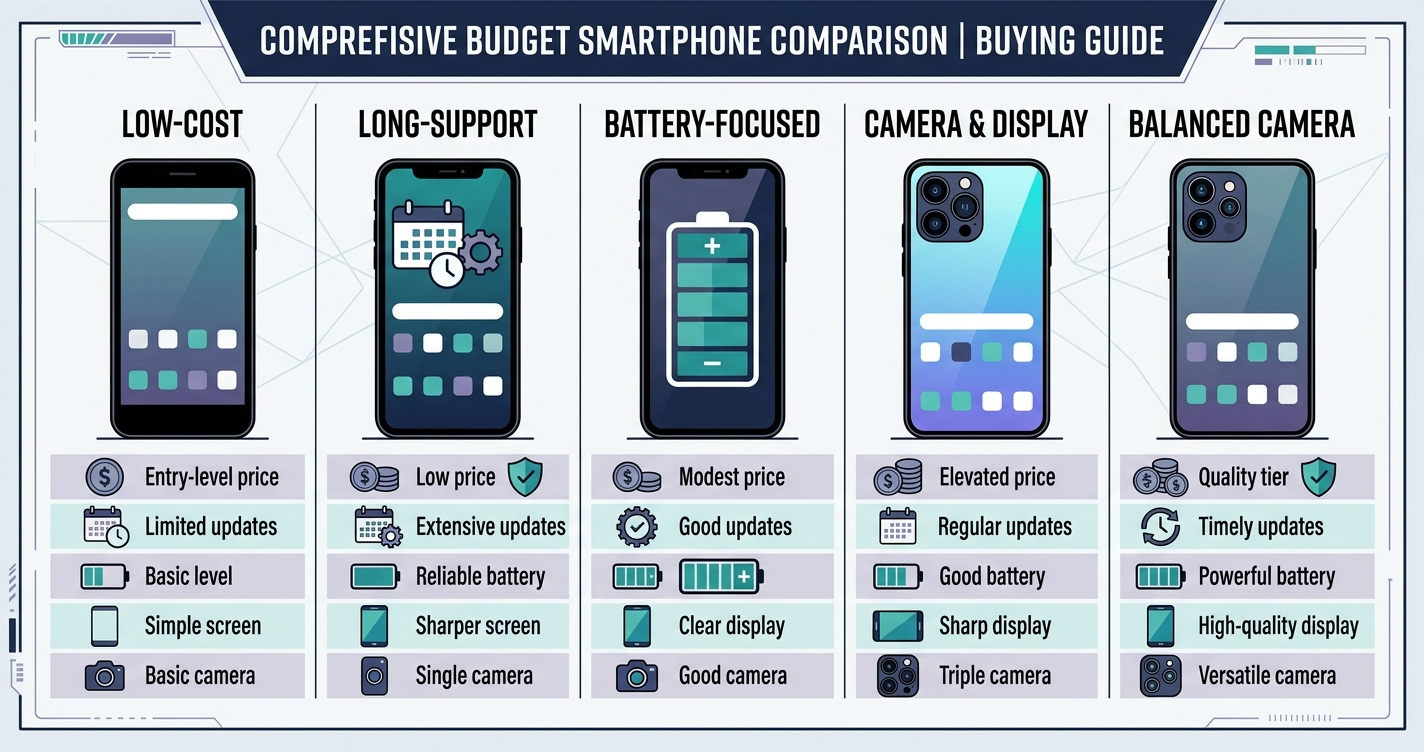
| Phone | Typical U.S. price shown in current sources | Best for | Main trade-off |
|---|---|---|---|
| Motorola Moto G (2026) | Around $199.99 at launch; seller pricing may vary | Keeping the price low | Basic performance and a shorter support horizon than some rivals |
| Samsung Galaxy A17 5G | $269.99 list price after October increase | Affordable screen and longer update commitment | Price has climbed from its launch level |
| Motorola Moto G Power (2026) | About $299.99 | Large screen and battery-focused use | Bulky design; performance is not its main strength |
| Nothing Phone (4a) Pro | $499 list; $419 promotional price reported by Nothing’s U.S. store | Strong display and versatile camera hardware near $500 | Software support is shorter than Google’s promise |
| Google Pixel 10a | $599 current list; discount listings have appeared | Camera and long software support | Much less compelling at full price after the increase |
Motorola Moto G (2026): The Low-Cost Pick
The Moto G (2026) is aimed at buyers who want a straightforward Android phone without spending much. Motorola lists a 6.7-inch 120Hz display, 50MP main camera, 5G, and up to 128GB storage. Its launch price was $199.99, though check current seller pricing because availability and promotions differ.motorola+1
It makes sense for basic use: messaging, browsing, video, and everyday apps. But a low price does not make it the strongest long-term choice. Before buying, check its memory configuration, storage needs, and update commitment. Tom’s Guide’s review noted the phone’s value at under $200, while its more recent comparison sources emphasize that support length and price can change the value calculation.tomsguide+1
The honest caveat: if the current price is close to $300, compare it with Samsung’s Galaxy A17 or a discounted Moto G Power. At that higher price, the basic Moto G is harder to justify unless you specifically want its size, software, or carrier deal.
Samsung Galaxy A17 5G: The Practical Everyday Option
Samsung’s Galaxy A17 5G offers a 6.7-inch display, 50MP main camera with optical image stabilization, 5,000mAh battery, and a promise of six OS upgrades and six years of security updates. The U.S. 128GB model is listed at $269.99 after a price increase.samsung+2
That support promise is meaningful if you keep phones for several years. It can make the A17 a more sensible purchase than a slightly cheaper model with a shorter update window—provided the phone’s performance and camera suit your expectations. Samsung’s official specifications list the display, camera, battery, and update commitment, but real photo quality and speed should be checked in independent reviews.
The honest caveat: the price has risen from its earlier launch level. It’s a better buy on discount, especially if you do not need the stronger camera or processing features of a more expensive model.
Motorola Moto G Power (2026): The Big-Screen, Battery-Focused Choice
The Moto G Power (2026) has a 6.8-inch 120Hz display, 8GB of RAM, 128GB storage, microSD expansion, and a 5,200mAh battery. Its U.S. price is around $299.99. In Tom’s Guide’s web-browsing battery test, it lasted an average of 18 hours and 22 minutes—a result from that publication’s specific test, not a guarantee for everyday use.tomsguide+1
Consider it if you want a large screen, expandable storage, and a battery-focused design. The microSD slot is useful if you store lots of media, but it does not replace internal storage for every app or task. Its size and weight also make it less comfortable for buyers who want a compact phone.
The honest caveat: don’t pay extra just because “Power” sounds like premium performance. This model’s appeal is its screen, battery, and storage flexibility—not class-leading speed or camera quality.
Nothing Phone (4a) Pro: The Feature-Rich Option Near $500
The Nothing Phone (4a) Pro offers a 6.83-inch AMOLED screen with a 144Hz refresh rate and a camera system that includes a 3.5x optical-zoom telephoto camera. It launched at $499 for its base configuration, and Nothing’s U.S. store has listed it at $419 during a promotion.nothing+1
It is a compelling choice if you value a distinctive design, smooth display, and camera versatility. Its zoom camera can be more useful than adding a low-quality macro sensor, especially for distant subjects. But promotional pricing changes, and the phone’s update commitment is shorter than Google’s seven-year promise for the Pixel 10a; CNET reports three years of Android updates and up to six years of security updates.cnet
The honest caveat: this is a budget phone only in the broader under-$500 category. If you’re strictly below $300, it is not the right comparison. Also check its camera consistency, water resistance, and software support against your priorities before choosing it.
Google Pixel 10a: Buy It for the Camera and Updates—At the Right Price
The Pixel 10a launched at $499 with a 48MP main camera, 13MP ultrawide camera, 6.3-inch display, and Google’s promise of seven years of OS, security, and feature updates. Google’s store currently lists it from $599, although discounts have appeared at retailers.blog+2
Its strongest case is the combination of camera processing and long support. If those matter more to you than a very large display or gaming performance, the Pixel can still make sense—especially when discounted. But its $599 list price pushes it beyond what many buyers mean by “budget.”
The honest caveat: don’t treat the original $499 review price as current. At full price, compare the Pixel with discounted rivals and newer midrange models. At a sale price closer to launch, its long update promise and camera make a stronger value argument.
How to Choose the Best Budget Phone for You
Start with your budget ceiling, then decide which two features matter most. Trying to maximize camera, battery, display, performance, durability, and updates at the lowest price usually leads to confusion. A clear priority makes the comparison easier.
- Set the maximum amount you can pay, including tax, delivery, a case, and a charger if needed.
- Decide whether camera quality, battery life, screen size, update support, or price matters most.
- Check the exact storage and memory configuration.
- Confirm the phone is unlocked or compatible with your carrier and local network bands.
- Read independent reviews of the exact model, focusing on camera, performance, and battery tests.
- Check the manufacturer’s software-update policy and warranty for your region.
- Compare the current price with similar phones—not only the launch price.
If you’re buying in Pakistan, do not assume U.S. pricing or warranties apply. Confirm PTA approval, local network compatibility, official warranty coverage, and the local price of the exact model. A gray-market phone may look cheaper but can carry trade-offs in warranty and network support.
The Mistakes That Keep Most People From Buying the Right Budget Phone
The first mistake is choosing by camera megapixels alone. A 50MP label does not tell you whether photos look good indoors, at night, or when subjects move. Look for sample photos and independent review results instead.
The second mistake is buying the cheapest model without checking software support. A low price can be less attractive if the manufacturer provides fewer years of updates. Compare support commitments and consider how long you plan to keep the phone.
The third mistake is trusting a review’s old price. Phone prices can change after launch, and a model praised at $200 may be less compelling at $270. Check the current price from the manufacturer and reputable retailers before deciding.
The fourth mistake is ignoring storage. Photos, apps, videos, and system files add up. If you keep a phone for several years, 128GB may be more comfortable than a smaller configuration; if the phone has a microSD slot, remember that expansion has limits and does not replace internal storage for every use.
The fifth mistake is overlooking carrier, warranty, and regional compatibility. An imported phone can have different network bands, payment features, eSIM support, or service terms. Verify the model number and local warranty rather than assuming all versions are identical.
The Fastest Path to the Right Budget Phone
Under $200: Look for a current sale on an entry-level phone and focus on reliable basics, battery, and carrier compatibility. The Moto G (2026) launched at $199.99, but compare its current price with Samsung’s A17 before buying.xfinity
Around $300: Choose between the Galaxy A17 for its update commitment and the Moto G Power for its larger screen, battery focus, and expandable storage. The better fit depends on whether long-term support or hardware flexibility matters more to you.
Near $500: Compare the Nothing Phone (4a) Pro and Pixel 10a based on current sale prices. Pick Nothing if you value its display and optical zoom; consider Pixel for its camera experience and longer update promise. For more budget options, see our guide to best smartphones under $300.
What Comes Next
Budget phones are no longer defined only by basic performance. Screens, cameras, 5G, and update commitments can all be strong at lower prices—but rising prices make it important to recheck value rather than rely on a phone’s launch reputation.
The most sensible buy is often a discounted phone that already meets your needs. Don’t pay extra for a feature you won’t use, but don’t ignore long-term support, storage, or warranty just to save a small amount upfront.
Compare current local prices, exact configurations, network compatibility, and support terms before placing an order. That’s how you find a phone that stays useful after the excitement of unboxing wears off.