Your freelance profile has 7 seconds to convince a buyer to stay — here is exactly how to make those seconds count.
Here is the statistic that should change how seriously you take your freelance profile.
On Fiverr, the average buyer spends 7 seconds on a seller’s profile before deciding to message them or move to the next result. Seven seconds. That is the window in which your profile photo, your headline, the first two lines of your description, and your gig thumbnail either build enough trust to keep a buyer reading — or fail to and send them somewhere else.
Most freelancers treat their profile as an afterthought. They fill in the required fields, upload a photo they already had, write two sentences about themselves, and wonder why the messages are not coming. Then they lower their price, wondering if that is the problem.
It is almost never the price. It is almost always the profile.
A professional freelance profile does one specific job: it takes a buyer who has never met you and makes them feel comfortable enough to send their project — and their money — to a stranger. Every element of the profile either contributes to that feeling of trust or undermines it. Understanding which elements matter most, and exactly how to optimise them, is the difference between a profile that generates consistent enquiries and one that generates silence.
Here is exactly how to build a professional freelance profile that gets clients in 2026 — platform by platform, element by element, with the specific details most guides skip.
Why Your Freelance Profile Is More Important Than Your Skill
This is the insight that most freelancing guides reverse — and the reversal costs beginners months of frustration.
Most beginners believe that if they develop a good enough skill, clients will find them. The skill is the product. The profile is just packaging. This mental model is wrong in a specific and consequential way: the profile is not packaging. It is the sales conversation that happens before any client ever sees your work.
Think about what a client on Fiverr or Upwork is actually doing when they search for a freelancer. They have a problem — a website that needs copy, a video that needs editing, a logo that needs designing. They search for relevant gigs and receive dozens of results. They cannot assess the skill of any of these freelancers directly because they have not seen the work yet. What they can assess is the professionalism of the presentation, the clarity of the offer, and the evidence that working with this person is a safe bet.
A skilled freelancer with a weak profile loses clients to a less skilled freelancer with a strong profile — consistently. The profile is not the packaging. It is the reason someone opens the package in the first place.
In 2026, the platforms where this dynamic plays out most significantly are Fiverr, Upwork, and LinkedIn. Each has different profile structures, different buyer expectations, and different optimisation requirements. The principles are the same. The implementation differs.
The 7 Elements of a Freelance Profile That Gets Clients
Element 1 — The Profile Photo
The profile photo is the first thing a buyer sees when your result appears in search — before they read your headline, your description, or your rating. It takes a fraction of a second to process, and the impression it creates colours every element they read afterward.
The research on profile photo impact in freelancing is consistent: profiles with professional, clear, face-forward photos generate 25 to 40% more click-throughs from search results than profiles with logos, illustrations, or low-quality personal photos. The reason is simple. Buyers are hiring a person. They want to see a face — and that face should signal competence, trustworthiness, and professionalism.
The specific requirements for a profile photo that converts:
Clear, well-lit face — no shadows, no harsh lighting
Plain or minimally distracting background — white, light grey, or a simple outdoor setting
Friendly but professional expression — a natural smile, not a forced grin
Professional or smart casual clothing — what you would wear to a client meeting
Shot from the shoulders up — not a full body photo, not a zoomed-out group photo
What to avoid is equally important. Sunglasses, group photos where you are not the obvious subject, blurry or pixelated images, pictures taken in bed or in a car, and photos with strong filters that make you look dramatically different from how you actually look — all of these undermine the trust signal the photo is supposed to create.
If you do not have a suitable photo, take one today. Natural light from a window, a plain wall as a background, and a phone with a decent camera is entirely sufficient. The quality of the photo matters less than the quality of the impression it creates.
Element 2 — The Headline or Profile Title
On Fiverr, this is your gig title. On Upwork, it is your professional title. On LinkedIn, it is your headline. In every case, it is the second thing a buyer reads after your photo — and the element that most directly determines whether they click through to learn more.
The mistake most freelancers make with their headline is describing themselves rather than describing their value. “Experienced Graphic Designer” describes you. “I design brand identities for food and beverage businesses” describes what you do for whom — which is what a buyer actually needs to know.
The headline that converts buyers follows a simple formula: skill + niche + outcome. You do not need all three every time, but the more specific the better. Compare these:
A weak headline: “Content Writer with 2 Years Experience” A strong headline: “SEO Blog Writer for SaaS and Tech Companies — 500 to 2,000 Word Articles Delivered On Time”
The strong headline tells a buyer in one sentence whether you are relevant to their need. It saves their time, signals competence, and filters in the right clients while filtering out the ones who need something different. Specificity is not limiting — it is clarifying. And clarity is what generates trust in the 7 seconds a buyer spends on your profile.
Element 3 — The Profile Description or Bio
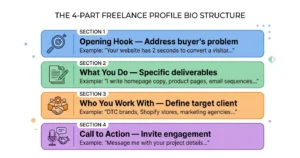
A freelance bio that converts follows this exact 4-part structure — most beginners skip parts 1 and 4.
The description is the longest and most flexible element of your profile — and the one where most beginners make their most consequential mistakes.
The two most common mistakes are writing about yourself in abstract terms — “I am passionate about design and committed to delivering quality” — and trying to impress buyers with vocabulary rather than clarity. Both mistakes produce the same result: a buyer who does not understand exactly what you offer, who you offer it to, and what makes working with you worth the price.
The profile description that converts has a specific structure:
Opening hook — address the buyer’s problem directly, not your passion for the craft. “Your website has two seconds to convince a visitor to stay. Generic copy loses them. Strategic copy keeps them reading — and converts them into customers.”
What you do — specific, concrete, with named deliverables. “I write conversion-focused homepage copy, product page descriptions, and email sequences for e-commerce brands. Every piece is researched, SEO-optimised, and delivered with a revision round included.”
Who you work with — define your target client. Buyers who see themselves in your description convert at a significantly higher rate than those who have to imagine whether you might be relevant. “I work primarily with direct-to-consumer brands, Shopify store owners, and DTC agencies.”
Why working with you is a good experience — not generic praise of yourself, but specific operational details. “I respond to all messages within 24 hours, provide a detailed brief questionnaire before starting work, and include one revision round in every order. If a deadline is at risk for any reason, I tell you before it becomes a problem.”
Call to action — end with an invitation to engage. “Message me with your project details and I will tell you within 24 hours whether I am the right fit.”
The ideal description length varies by platform. Fiverr descriptions work best between 150 and 300 words — buyers on Fiverr scan quickly. Upwork proposals and profiles support longer descriptions because the platform’s buyer culture expects more detail. LinkedIn profiles work best with 150 to 250 words in the About section.
Element 4 — Portfolio and Work Samples
The portfolio is the element of your profile that closes the sale — because it is the first moment a buyer can see direct evidence of what they will receive if they hire you.
The excuse most beginners use — “I do not have any client work to show” — is understandable but surmountable. A portfolio of well-executed self-initiated projects is entirely legitimate evidence of capability. Clients are not evaluating your employment history. They are evaluating whether you can solve their problem. A self-created sample that demonstrates exactly the type of work they need is sufficient proof.
The portfolio building strategy for beginners depends on the skill:
Content writers should create three to five articles on topics relevant to their target niche, formatted as they would be published, and either host them on a free Medium account or a simple personal website.
Graphic designers should create five to eight logo designs or social media graphic sets in the style they plan to offer, using a range of industries to show versatility.
Video editors should edit two to three short-form videos — sourcing free footage from Pexels or Unsplash if needed — demonstrating their pacing, colour grading, and caption style.
Web developers should build one to two demo websites — either for fictional businesses or for actual local businesses who will accept a free site in exchange for a portfolio reference.
The quality of your portfolio samples sets the expectation for every project you take on. Do not rush them. The 20 hours invested in producing strong portfolio samples will generate a return across every client who sees them.
Element 5 — Skills, Certifications, and Profile Completeness
Every major freelancing platform uses profile completeness as a ranking signal. Incomplete profiles rank lower in search results — regardless of gig quality. The platforms interpret a partially filled profile as a signal that the seller is not serious about their presence on the platform.
Complete every field the platform offers. Skills, education, certifications, languages, and portfolio items all contribute to profile completeness scores that directly affect search visibility. On Fiverr, a complete profile receives better initial distribution when new gigs are created. On Upwork, profile completeness affects your search ranking in buyer searches.
Certifications matter less than most beginners assume — clients do not typically read certification lists in detail. But completing the certification fields as part of overall profile completeness does affect your ranking. If a relevant free certification exists — Fiverr’s own Fiverr Learn courses, Google’s free digital marketing certification, HubSpot’s content marketing certification — adding it costs nothing and contributes to completeness without misleading buyers about your credentials.
Element 6 — Pricing Structure
Pricing is a trust signal before it is an income calculation — and most beginners price in ways that undermine trust rather than communicate value.
The mistake is underpricing. A $5 gig on Fiverr does not attract bargain-hunting clients who are happy to receive $5 worth of quality. It attracts clients who expect extensive revision, rapid turnaround, and a level of attention that a $5 fee cannot justify. These clients leave mediocre reviews, request additional work without paying, and consume significantly more time than they generate in income.
Pricing based on the value you deliver — not your anxiety about being rejected — is a counterintuitive but consistently validated principle in freelancing. The clients who pay $50 for a service that others offer at $20 are not being overcharged. They are buying the confidence that comes with a seller who values their own work.
The three-tier pricing structure that Fiverr uses — Basic, Standard, Premium — should be designed so that Standard is the obvious choice: meaningfully better than Basic, substantially cheaper than Premium, and priced to attract the type of client who pays fairly and appreciates quality. Most orders come in at the Standard tier. Price it to represent your best sustainable value.
Element 7 — Response Rate and Online Status
The elements of your profile that buyers cannot see directly — your response rate, your response time, and your online status — are factors that Fiverr and Upwork’s algorithms weight heavily in search rankings.
Fiverr’s algorithm prioritises sellers who are online and responsive. Installing the Fiverr mobile app and maintaining an active status during your working hours directly impacts how frequently your gigs appear in search. Buyers who message you and receive a response within an hour are significantly more likely to place an order than buyers who message you and receive a response two days later — not just because of the practical convenience, but because response time is a proxy for professional reliability.
Upwork’s Job Success Score — the metric that most directly affects your search visibility on that platform — is influenced by your response rate to contract offers and client messages. Maintaining a response rate above 90% is a prerequisite for the Rising Talent badge and the Top Rated designation that unlock better search positioning and higher rate ceilings.
Platform-Specific Profile Tips — Fiverr vs Upwork vs LinkedIn
Fiverr Profile Optimisation
Fiverr buyers are typically looking for quick, defined deliverables at a clear price. The profile optimisation priorities for Fiverr are:
Gig thumbnail quality — the visual that appears in search results is often more important than the gig title for click-through rate
Gig video — adding a 60-second video increases conversion rates by over 200% according to Fiverr’s own data. Phone video with clear audio is sufficient
Package clarity — the difference between Basic, Standard, and Premium packages should be immediately obvious without reading fine print
FAQ section within the gig — pre-answering common buyer questions reduces friction and demonstrates that you understand what buyers typically need
Upwork Profile Optimisation
Upwork buyers are typically looking for longer-term working relationships and are willing to invest more time evaluating candidates. The profile priorities for Upwork are:
Hourly rate — set a rate that reflects your target market, not your anxiety about rejection. Upwork’s Top Rated sellers command rates 40 to 60% higher than the platform average
Specialised profile — Upwork allows multiple specialised profiles for different service offerings. Creating a specialised profile for each distinct service dramatically improves search visibility for each offering
Portfolio diversity — Upwork buyers spend more time in portfolio sections than Fiverr buyers. Include three to five portfolio items with detailed descriptions of the problem, your approach, and the outcome
LinkedIn Profile Optimisation
LinkedIn is the platform where the highest-value direct clients are found — and where a strong profile can generate inbound enquiries without active proposal submission.
The LinkedIn profile elements that generate inbound freelancing clients are the headline, the About section, and the Featured section where you pin your strongest portfolio pieces. Connection with people in your target client category — combined with consistent, genuinely useful content about your area of expertise — generates enquiries from buyers who have already seen your thinking before reaching out.
The Mistakes That Keep Freelance Profiles From Getting Clients
The first mistake is trying to appeal to everyone. A profile that offers writing, design, video editing, SEO, and social media management communicates that the freelancer has no particular expertise in anything. Buyers looking for a specialist — which is most buyers — move on immediately. Pick one service, define one target client, and build your profile around that specific combination.
The second mistake is copying other freelancers’ profiles. Platforms detect duplicate content in profiles and gig descriptions and reduce visibility accordingly. More importantly, a copied profile describes someone else’s experience and positioning, not yours — which means it will not attract the right clients even when it does rank. Write your own profile in your own voice, describing your own specific approach.
The third mistake is writing for search engines rather than buyers. Keyword-stuffed profiles that repeat “SEO writer SEO content SEO articles SEO blog posts” in every sentence are immediately recognisable as low-quality to any buyer who reads them. Write naturally, use relevant terms where they fit naturally, and trust that clarity and specificity will serve SEO better than stuffing.
The fourth mistake is treating the profile as a one-time task. The most effective freelance profiles in 2026 are updated regularly — adding new portfolio samples as projects are completed, refining the description based on the questions buyers actually ask, and adjusting pricing as reputation builds. A profile that was set up six months ago and never updated is losing ground to profiles that are actively maintained.
The fifth mistake is ignoring social proof. Reviews on Fiverr, the Job Success Score on Upwork, and LinkedIn recommendations are the most powerful trust signals available on each platform — and they are the result of every client interaction, not just the work itself. Clients who had a good experience but were not asked for a review typically do not leave one. At the end of every successful project, thank the client, confirm their satisfaction, and mention that a review is genuinely helpful for your freelancing career. Most satisfied clients are happy to leave one when asked directly. For a complete understanding of how to turn a strong profile into your first actual order on Fiverr, our guide on how to get your first order on Fiverr covers the full system from profile creation to delivery.
What Comes Next
The freelance profile is not a task you complete once and move on from. It is a living document that should improve with every client interaction, every portfolio addition, and every piece of feedback — direct or inferred — that tells you what buyers are actually responding to.
The freelancers earning the most in 2026 are not necessarily the most skilled. They are the ones who have built the most persuasive case for why a buyer should trust them with their project. A strong profile is that case — made in 7 seconds, refined over months, and worth every hour invested in getting it right.
For anyone who also wants to understand the full picture of how freelancing works beyond the profile — platforms, income timelines, client management, and scaling — our guide on what is freelancing and how to earn money online covers the complete foundation. And for understanding how AI tools can help you manage more clients and produce higher quality work with less time per project, our guide on how to make money with AI tools in 2026 shows exactly how to integrate AI into a freelancing workflow.
One professional profile. One clear niche. That is the foundation everything else is built on.
Ali Raza is a freelancing expert with 3+ years of experience on platforms like Fiverr. At Eblowee, he shares practical guides on online earning, freelancing, and digital skills for beginners